
Book Review – The Richest Man in Babylon
The Richest Man in Babylon is a personal finance book written by George Samuel Clason in 1926. It is a small book with less than 150 pages, but has sold over 2 million copies and is considered to be a classic. Clason uses interesting stories set in ancient Babylon to teach us about fundamental ideas in personal finance.
When I heard about the book, the first thought that came to my mind is how can a century old book on personal finance be relevant in 2022? Well, it turns out that almost every idea in it is very much relevant even today. In fact, considering that this is a general principles book rather than of the concrete action items or of specific investment options, it will be relevant in the coming years as well.
There is a lot of interest in the concepts of personal finance, financial independence and early retirement in recent years. It is fascinating that this 100 year old book explores similar themes. The first chapter(The man who desired gold) itself is about financial independence and early retirement told from the perspective of Bansir, the chariot builder.
The book starts by telling us that the aim of the book is financial success for its readers. In short, the book is about earning money, keeping money and making the money earn more money. Clason then sets the background of the ancient Babylon of 6000 BC where folks are generally rich (historical accuracy obviously takes a backseat). He tells us that the prosperous city was protected by walls which were as high as 150 feet. He reminds us that,
Money is governed today by the same laws which controlled it when prosperous men thronged the streets of Babylon, six thousand years ago.
One important thing to keep in mind when you read the book is that originally the chapters were pamphlets created for banks and insurance companies. Which explains why there are chapters on getting some protection for your money and it is complimented by the chapter on the need to avoid greed. Since it is based on pamphlets, there is some overlap on the ideas as well. For example, there is a chapter on 7 cures for a lean purse and there is a chapter on 5 laws of gold with some shared themes.
It is interesting to note that even 100 years ago, the importance for early retirement and the ability to generate passive income was recognized by Clason. To quote from the book,
I tell you, my students, a man’s wealth is not in the coins he carries in his purse; it is the income he buildeth, the golden stream that continually floweth into his purse and keepeth it always bulging. That is what every man desireth. That is what thou, each one of thee desireth; an income that continueth to come whether thou work or travel.
Clason also coined the term, pay yourself first. In fact, one of the basic principles which is explained multiple times across chapters is to save 10% of income before even planning any expenses. In the modern world, there will be very few who cannot afford saving 10%. Many of us would be able to save 30% or more if we just control some of our biggest desires.
The core of the book is the chapter titled “Seven Cures for a Lean Purse”. The basic strategy he advocates is to pay yourself first, control unnecessary expenditures, invest wisely to multiply the money, protect it from loss, have an own house, prepare a future income and finally increase the ability to make money. One piece of advice that stands out is the home ownership which is usually expensive, but many folks on the FIRE movement (Money Moustache for example) recognizes buying a good house in a nice neighbourhood as a wise decision. Clason is persuasive on this idea,
No man’s family can fully enjoy life unless they do have a plot of ground wherein children can play in the clean earth and where the wife may raise not only blossoms but good rich herbs to feed her family.
When you closely analyse the stories and the ideas in the book, you will realise that most of the popular books on the subject do contain same material with a more modern context. The ideas remain the same. The main difference here is that Clason focuses on general principles rather than specific techniques or investment types. For example, the book has sound advice when it comes to procrastination and the need to grab opportunities that come our way. In the chapter, Meet the goddess of good luck, we learn the story of the merchant who waits on a great deal for a flock of sheep and later regrets when someone else grabs the offer. Clason reminds us,
Good luck can be enticed by accepting opportunity.
The final chapters talk about financial discipline needed for getting out of debt. The long term progress of clearing the debt is presented as a set of fictitious tablets written by Dabasir, a camel trader from ancient Babylon.
Some may find it irritating that the characters in the story use old English in the conversations. I liked it since it reminded me that these conversations and ideas are relevant even in ancient times.
One of my favourite sentences is the closing paragraph of the book,
So saying Hadan Gula pulled the jewelled baubles from his ears and the rings from his fingers. Then reining his horse, He dropped back and rode with deep respect behind the Leader of the caravan.
Just like Hadan Gula, some readers may change their perspective on personal finance after reading the book!
Interesting Quotes from The Richest Man in Babylon
- Babylon became the wealthiest city of the ancient world because its citizens were the richest people of their time. They appreciated the value of money. They practiced sound financial principles in acquiring money, keeping money and making their money earn more money.
- If you have not acquired more than a bare existence in the years since we were youths, it is because you either have failed to learn the laws that govern the building of wealth, or else you do not observe them.
- I found the road to wealth when I decided that a part of all I earned was mine to keep. And so will you.
- Every gold piece you save is a slave to work for you. Every copper it earns is its child that also can earn for you. If you would become wealthy, then what you save must earn, and its children must earn, that all may help to give to you the abundance you crave.
- Advice is one thing that is freely given away, but watch that you take only what is worth having. He who takes advice about his savings from one who is inexperienced in such matters, shall pay with his savings for proving the falsity of their opinions.
- Opportunity is a haughty goddess who wastes no time with those who are unprepared.
- That what each of us calls our ‘necessary expenses’ will always grow to equal our incomes unless we protest to the contrary.
- Provide in advance for the needs of thy growing age and the protection of thy family.
- Preceding accomplishment must be desire. Thy desires must be strong and definite. General desires are but weak longings.
- Thus the seventh and last remedy for a lean purse is to cultivate thy own powers, to study and become wiser, to become more skillful, to so act as to respect thyself. Thereby shalt thou acquire confidence in thy self to achieve thy carefully considered desires.
- But I was stubborn and refused to make payment that night. Next morning, before I awoke, the city gates opened and four buyers rushed out in search of flocks. They were most eager and willing to pay high prices because the city was threatened with siege, and food was not plentiful. Nearly three times the price at which he had offered the flock to me did the old farmer receive for it. Thus was rare good luck allowed to escape.
- So must every man master his own spirit of procrastination before he can expect to share in the rich treasures of Babylon.
- Good luck can be enticed by accepting opportunity.
- I thought not that you would. But it is there and simple too. Just this: If you desire to help thy friend, do so in a way that will not bring thy friend’s burdens upon thyself.
- Better a little caution than a great regret.
- The hungrier one becomes, the clearer one’s mind works — also the more sensitive one becomes to the odors of food.
- Where the determination is, the way can be found.
- Thy grandfather said something to me one day that I shall always remember. ‘I like thy cakes, boy, but better still I like the fine enterprise with which thou offerest them. Such spirit can carry thee far on the road to success.’
The Richest Man in Babylon – Summary
Following is a chapter wise summary of the book. I use it as a quick reference to the book and also to periodically remind me of the content. Obviously I would recommend you to read the book first before going through this section. However if you are impatient and are looking for a quick summary of the book, read on,
Chapter 1 – The Man Who Desired Gold
Bansir, the chariot builder, looks at his meagre assets after years of work and shares his concern with Kobbi, the musician. Kobbi suggests meeting Arkad (the richest man in Babylon) and points out that Arkad’s son Nomasir also seems to have the same skill of making money.
Chapter 2 – The Richest Man in Babylon
Arkad tells his friends that the secret of getting rich is paying yourself first. He learnt it from Algamish, the money lender. His advice was – “You first learned to live upon less than you could earn. Next you learned to seek advice from those who were competent through their own experiences to give it. And, lastly, you have learned to make gold work for you.”
Chapter 3 – Seven Cures for a Lean Purse
King Sargon asks for Arkad’s advice on what people should do for wealth. Arkad gives them 7 cures,
- The First Cure — Start Thy Purse to Fattening
- The Second Cure — Control Thy Expenditures
- The Third Cure — Make Thy Gold Multiply
- The Fourth Cure — Guard Thy Treasures from Loss
- The Fifth Cure — Make of Thy Dwelling a Profitable Investment
- The Sixth Cure — Insure A Future Income
- The Seventh Cure — Increase Thy Ability to Earn
Chapter 4 – Meet the Goddess of Good Luck
This is a talk by Arkad in the temple of learning discussing the importance of luck. The key themes are embracing opportunity immediately and avoiding procrastination.
Chapter 5 – The Five Laws of Gold
Kalabab (trader) tells the story of Nomasir and how Arkad asked his son Nomasir to find his own way with a tablet of wisdom and gold. How Nomasir squandered the gold and later became prosperous by using the tablet of wisdom containing 5 laws of gold.
- Gold cometh gladly and in increasing quantity to any man who will put by not less than one-tenth of his earnings to create an estate for his future and that of his family.
- Gold laboreth diligently and contentedly for the wise owner who finds for it profitable employment, multiplying even as the flocks of the field.
- Gold clingeth to the protection of the cautious owner who invests it under the advice of men wise in its handling.
- Gold slippeth away from the man who invests it in businesses or purposes with which he is not familiar or which are not approved by those skilled in its keep.
- Gold flees the man who would force it to impossible earnings or who followeth the alluring advice of tricksters and schemers or who trusts it to his own inexperience and romantic desires in investment.
Chapter 6 – The Gold Lender of Babylon
Rodan the spearmaker gets a gift of 50 pieces of gold from the King and asks Mathon, the money lender what to do about the fortune. His sister is asking for it for her husband’s venture. Mathon shows him the details of how he lends people money. He has this advice for Rodan,
I thought not that you would. But it is there and simple too. Just this: If you desire to help thy friend, do so in a way that will not bring thy friend’s burdens upon thyself.
Chapter 7 – The Walls of Babylon
Through the parable of the strong and tall walls of Babylon, we learn the importance of financial protection in our lives.
Chapter 8 – The Camel Trader of Babylon
Tarkad has lot of debts and is without food for 2 days. He meets one of his lenders (Dabasir, the camel trader). Dabasir takes him to the hotel and tells him the story of how he became a camel trader from a slave in Syria. This story is about the role of determination in success.
Chapter 9 – The Clay Tablets from Babylon
This section contains the 5 clay tablets supposedly Dabasir has written while clearing his debts. He saves 1/10, spends 7/10 and then uses 2/10 to systematically pay his debtors. He gets his advice from Mathon, the gold lender. The chapter also contains letters from the archaeology department who after reading the tablets apply it in their own lives!
Chapter 10 – The Luckiest Man in Babylon
The story of Sharru Nada, the merchant prince of Babylon. He tells his story to Hadan Gula, grandson of Arad Gula while travelling from Damascus to Babylon. Nada was taken slave, but then worked hard to get his freedom. He was finally bought by Arad who freed him and made him his partner. This parable is about the importance of work in our lives.
Book Review – The Psychology of Money
The Psychology of Money is a self-help book written by Morgan Housel. It is a short book of around 250 pages containing timeless lessons on wealth, greed and happiness. The book was published right in the middle of the Covid Pandemic (September 2020) and went on to sell over a million copies within a year! The timing of the book was perfect; a lot of people were re-evaluating their lives during the pandemic and this book offered some solid life guidance especially on personal finance.
The book is based on a blog post written by Morgan titled “The Psychology of Money” in June 2018. In the introduction section of the blog Morgan explains his attempt,
This report describes 20 flaws, biases, and causes of bad behavior I’ve seen pop up often when people deal with money.
The book explores these ideas in much more detail and explores themes outside money as well. I enjoyed reading both. If you prefer the slow burn of a book which goes through many examples to explain a concept, the book is for you.
The book is prescriptive in nature and some folks may find it off-putting. Some may argue that there isn’t much of a “psychology of money” in the book. But I agree with the author when he says that many people need to be told of the obvious things,
Singer Rihanna nearly went bankrupt after overspending and sued her financial advisor. The advisor responded: “Was it really necessary to tell her that if you spend money on things, you will end up with the things and not the money?”
The book consists of 20 small chapters each dealing with a core concept related to human behaviour and human biases. The title of the book is apt since Morgan has focused on our behaviours and biases that have a strong impact on our financial stability and health. I have kept the book on the bedside table since I want to reiterate to myself about some of these important ideas.
The book starts with a very persuasive story of Ronald Read, a janitor who by steady saving of his meagre income went on to accumulate over 8 million dollars of wealth! Morgan tells us that behaviour is important than intelligence when it comes to managing money,
The premise of this book is that doing well with money has a little to do with how smart you are and a lot to do with how you behave. And behaviour is hard to teach, even to really smart people.
In the first chapter Morgan argues that however hard we try, it may not be possible to always see things from the perspective of another person. Our mistake is to judge things with our very limited money experience and that can be a problem. This chapter also refers to the working conditions in large companies such as Foxconn. Morgan tries to be politically correct when talking about this subject. But most Americans or for that matter most folks in first world countries have no clue how hard life can be in third world countries. Morgan quotes nephew of a chinese worker,
The idea of working in a “sweat shop” compared to that old lifestyle is an improvement, in my opinion. I know that my aunt would rather be “exploited” by an evil capitalist boss for a couple of dollars than have her body be exploited by several men for pennies.
We need to be very careful in judging people and their behaviour, especially when poverty and poor living conditions are involved.
The book also has plenty of life advice. Morgan explores the dual nature of luck and risk, the importance of contentment and how being reasonable is more important than being rational. He reminds us that,
Long-term planning is harder than it seems because people’s goals and desires change over time.
When it comes to personal finance, this book has some really good advice packaged with interesting facts and personal stories. We learn how the same principle of exponential growth due to compounding is behind both ice ages and wealth generation. He explores the relation between money, happiness and freedom. I fully agree with Morgan when he writes,
Controlling your time is the highest dividend money pays.
I am a big fan of Nassim Nicholas Taleb, whom I consider to be one of the best original thinkers of our time. Morgan quotes Taleb multiple times in the book especially in the context of risk and the importance of unexpected events in our lives. Whether it is investing or planning for the future, we need to be prepared for the unexpected.
The Psychology of Money is the book I wish I had read when I was young. That would have made a huge change to my current financial position. But as they say, better late than never!
As James Clear (author of Atomic Habits) says in the book – “Everyone should own a copy” of this book.
The Psychology of Money – Book Summary
Whenever I read a book, I always prepare a one page summary. The book psychology of money is a mix of factual analysis and practical guidance on personal finance and money in general. In this case my book summary is a set of instructions to remind myself of what I should do based on the learnings from the book.
- When making money decisions, beware of your limited knowledge and experience.
- Focus on broader ideas and patterns instead of specific individuals and their actions.
- Train and remind yourself to be content, there are things not worth risking.
- Long term steady investment can give compounding returns.
- Be optimistic about future, but paranoid about things that can affect that future.
- Apply the principle of stop-loss to your life.
- Use money to control your time. That is freedom.
- Be humble, kind and empathetic. It will bring respect.
- Don’t spend money on things you don’t need. Save money.
- Being reasonable than trying to be coldly rational gives us peace of mind.
- Plan ahead. But also think about what happens when the plan goes wrong.
- Beware that you and everyone around you will change over time.
- Every decision has a price that you should be ready to pay.
- Before any comparison and decision making, make sure that both sides are playing the same game!
- Avoid extreme decisions since things can change.
Top 10 Lessons from the Book – The Psychology of Money
- Less ego, more wealth.
- Manage your money in a way that helps you sleep at night.
- If you want to do better as an investor, the single most powerful thing you can do is increase your time horizon.
- Become OK with a lot of things going wrong. You can be wrong half the time and still make a fortune.
- Use money to gain control over your time.
- Save. Just save. You don’t need a specific reason to save.
- Define the cost of success and be ready to pay it.
- Worship room for error.
- Avoid the extreme ends of financial decisions.
- You should like risk because it pays off over time.
Interesting Quotes from the Psychology of Money Book
- The premise of this book is that doing well with money has a little to do with how smart you are and a lot to do with how you behave. And behaviour is hard to teach, even to really smart people.
- I love Voltaire’s observation that “History never repeats itself; man always does.” It applies so well to how we behave with money.
- Everyone has their own unique experience with how the world works. And what you’ve experienced is more compelling than what you learn second-hand. So all of us—you, me, everyone—go through life anchored to a set of views about how money works that vary wildly from person to person. What seems crazy to you might make sense to me.
- The challenge for us is that no amount of studying or open-mindedness can genuinely recreate the power of fear and uncertainty.
- Nothing is as good or as bad as it seems.
- Bill Gates experienced one in a million luck by ending up at Lakeside. Kent Evans experienced one in a million risk by never getting to finish what he and Gates set out to achieve.
- “The customer is always right” and “customers don’t know what they want” are both accepted business wisdom.
- Be careful who you praise and admire. Be careful who you look down upon and wish to avoid becoming.
- Therefore, focus less on specific individuals and case studies and more on broad patterns.
- The hardest financial skill is getting the goalpost to stop moving.
- Modern capitalism is a pro at two things: generating wealth and generating envy. Perhaps they go hand in hand; wanting to surpass your peers can be the fuel of hard work. But life isn’t any fun without a sense of enough. Happiness, as it’s said, is just results minus expectations.
- There are many things never worth risking, no matter the potential gain.
- His skill is investing, but his secret is time.
- Good investing is not necessarily about making good decisions. It’s about consistently not screwing up.
- More than I want big returns, I want to be financially unbreakable. And if I’m unbreakable I actually think I’ll get the biggest returns, because I’ll be able to stick around long enough for compounding to work wonders.
- Planning is important, but the most important part of every plan is to plan on the plan not going according to plan.
- A barbelled personality – optimistic about the future, but paranoid about what will prevent you from getting to the future – is vital.
- You can be wrong half the time and still make a fortune.
- A lot of things in business and investing work this way. Long tails – the farthest ends of a distribution of outcomes – have tremendous influence in finance, where a small number of events can account for the majority of outcomes.
- Napoleon’s definition of a military genius was, “The man who can do the average thing when all those around him are going crazy.” It’s the same in investing.
- At the Berkshire Hathaway shareholder meeting in 2013 Warren Buffett said he’s owned 400 to 500 stocks during his life and made most of his money on 10 of them. Charlie Munger followed up: “If you remove just a few of Berkshire’s top investments, its long-term track record is pretty average.”
- Having a strong sense of controlling one’s life is a more dependable predictor of positive feelings of wellbeing than any of the objective conditions of life we have considered.
- Your kids don’t want your money (or what your money buys) anywhere near as much as they want you. Specifically, they want you with them.
- No one is impressed with your possessions as much as you are.
- Humility, kindness, and empathy will bring you more respect than horsepower ever will.
- Spending money to show people how much money you have is the fastest way to have less money.
- The first idea – simple, but easy to overlook – is that building wealth has little to do with your income or investment returns, and lots to do with your savings rate.
- In a world where intelligence is hyper-competitive and many previous technical skills have become automated, competitive advantages tilt toward nuanced and soft skills – like communication, empathy, and, perhaps most of all, flexibility.
- Aiming to be mostly reasonable works better than trying to be coldly rational.
- One is that “minimising future regret” is hard to rationalise on paper but easy to justify in real life.
- History is mostly the study of surprising events. But it is often used by investors and economists as an unassailable guide to the future.
- Benjamin Graham advocated purchasing stocks trading for less than their net working assets – basically cash in the bank minus all debts. This sounds great, but few stocks actually trade that cheaply anymore – other than, say, a penny stock accused of accounting fraud.
- The most important part of every plan is planning on your plan not going according to plan.
- The purpose of the margin of safety is to render the forecast unnecessary.
- Nassim Taleb says, “You can be risk loving and yet completely averse to ruin.”
- A good rule of thumb for a lot of things in life is that everything that can break will eventually break.
- Long-term planning is harder than it seems because people’s goals and desires change over time.
- Charlie Munger says the first rule of compounding is to never interrupt it unnecessarily.
- Every job looks easy when you’re not the one doing it because the challenges faced by someone in the arena are often invisible to those in the crowd.
- The trick is convincing yourself that the market’s fee is worth it. That’s the only way to properly deal with volatility and uncertainty – not just putting up with it, but realising that it’s an admission fee worth paying.
A takeaway here is that few things matter more with money than understanding your own time horizon and not being persuaded by the actions and behaviours of people playing different games than you are. The main thing I can recommend is going out of your way to identify what game you’re playing. - Optimism sounds like a sales pitch. Pessimism sounds like someone trying to help you.
- John Stuart Mill wrote in the 1840s: “I have observed that not the man who hopes when others despair, but the man who despairs when others hope, is admired by a large class of persons as a sage.”
- There is an iron law in economics: extremely good and extremely bad circumstances rarely stay that way for long because supply and demand adapt in hard-to-predict ways.
- There are lots of overnight tragedies. There are rarely overnight miracles.
- In investing you must identify the price of success— volatility and loss amid the long backdrop of growth—and be willing to pay it.
- The more you want something to be true, the more likely you are to believe a story that overestimates the odds of it being true.
- Everyone has an incomplete view of the world. But we form a complete narrative to fill in the gaps.
- Psychologist Philip Tetlock once wrote: “We need to believe we live in a predictable, controllable world, so we turn to authoritative-sounding people who promise to satisfy that need.”
- NASA’s New Horizons spacecraft passed by Pluto two years ago. It was a three-billion mile trip that took nine and a half years. According to NASA, the trip “took about one minute less than predicted when the craft was launched in January 2006.”
Book Review – Four Thousand Weeks
Four thousand weeks is a time management/self help book by Oliver Burkeman. In his blog, Burkeman tells us that it is a book about the power of embracing your limitations. The name of the book, four thousand weeks, refers to the average lifespan of a human being rounded to a nice figure. There is something scary about expressing our lifetime in weeks, it seems too short.
Published in the middle of the Covid pandemic (August 2021), this book was an instant hit. The book’s message of embracing the shortness of our lives was a kind of therapy many needed. The first thing you notice about the book is the cover picture and how soothing it is!
Oliver Burkeman has been writing on the topic for a long time. For over 14 years(2006 – 2020), he wrote a popular column on psychology called “This Column Will Change Your Life” for the Guardian. Previously he has written two books, The Antidote: Happiness for People Who Can’t Stand Positive Thinking and HELP!: How to Become Slightly Happier and Get a Bit More Done.
Originally the subtitle of the book was time and how to use it, but it seems to have been changed to time management for mortals. In my opinion, a better way to describe the book will be “life – take it easy“. Burkeman argues that many of the modern productivity and time management concepts simply don’t work and cause a lot of pain. He calls himself a “recovering productivity geek” who was once obsessed with productivity hacks and techniques. He argues that most of these techniques don’t solve the problem of finitude of our lives and we need a different strategy of acceptance to deal with it.
The book starts with Burkeman convincing us that our limited time is something that is the root of many of our issues. He tells us,
Arguably, time management is all life is. Yet the modern discipline known as time management—like its hipper cousin, productivity—is a depressingly narrow-minded affair, focused on how to crank through as many work tasks as possible, or on devising the perfect morning routine, or on cooking all your dinners for the week in one big batch on Sundays.
Many of us will agree with Burkeman when he says,
In fact, I did get better at racing through my to-do list, only to find that greater volumes of work magically started to appear.
Burkeman not only explores the issues of finitude but also gives some practical suggestions on how to deal with it. I agree with him that the virtue of patience is underrated. I liked his advice on developing patience – (1) develop a taste for problems (2) embrace radical incrementalism (3) understand that originality lies on the far side of unoriginality.
In under 300 pages, Burkeman takes us through the importance of selective procrastination, the all pervasive issue of distraction and modern technology, the importance of pleasure for its own sake, virtue of patience, the loneliness of the free digital nomad and how our acceptance of our irrelevance in the universe can actually help us!
One common theme of the book is that we should make our life decisions, accept them and then deal with it. He tells us to embrace JOMO (Joy of Missing Out) instead of FOMO (Fear of Missing Out). He tells us,
(The original Latin word for ‘decide’, decidere, means ‘to cut off’, as in slicing away alternatives; it’s a close cousin of words like ‘homicide’ and ‘suicide’.) Any finite life – even the best one you could possibly imagine – is therefore a matter of ceaselessly waving goodbye to possibility.
I like his advice on dating and romance where he goes against the western cultural thinking of delaying marriage and “settling”. Burkeman is very clear in his thinking,
The received wisdom, articulated in a thousand magazine articles and inspirational Instagram memes, is that it’s always a crime to settle. But the received wisdom is wrong. You should definitely settle.
I agree with him and I also note that this is also a cultural thing. In my society (South India), the social consensus (at least now) is to settle. Marriages happen with very little dating or “getting to know each other”, but still a lot of these marriages are successful simply because people move on with their decisions.
I am a fan of the personal finance classic, The Richest Man in Babylon. I couldn’t help but chuckle when Burkeman tells us that the Principle number one is to pay yourself first when it comes to time.
The book ends with 10 tools for embracing your finitude which seems like something added on the insistence of the publisher or editor. I liked his advice of practising the art of doing nothing, but disagree on the advice to see boring and single purpose technology. Clearly it is something that depends on the individual, his needs and what he can afford.
Four thousand weeks is a well researched book with historical references and quotes from Tao, Seneca and modern studies on human behaviour. Burkeman writes humorously and with humility and that goes a long way making this book an interesting and worthwhile read!
Book Summary – Four Thousand Weeks
Four thousand weeks consists of twenty chapters organised in two sections – Choosing to Choose and Beyond Control.
Part I – Choosing to Choose contains the following chapters,
- The limit-embracing life. Accept that time is limited and even with prioritisation, everything won’t get done. Confessions from a productivity geek on how productivity hacks bring more misery.
- The efficiency trap. The more you get efficient at something, you feel there are much more possibilities and things to get done. Don’t operate under the illusion of one day making time for everything. The pitfalls of convenience.
- Facing finitude. Our lives are finite. Accepting finitude and moving on is important in our lives. Heidegger says that our being is defined by our finite time. The latin word for decide means to cut off.
- Becoming a better procrastinator. The lie of first things first. Three principles – the art of creative neglect, pay yourself first when it comes to time. Second is to limit your work in progress. Third is to resist the allure of medium priorities. The inevitability of settling and how it can help.
- The Watermelon problem – The Buzzfeed How Many Rubber Bands Does It Take To Explode A Watermelon? video in 2016 and the problem of distraction. The silicon valley software/social media cause not only time wastage but also influence how the society is working.
- The Intimate Interrupter – We try to avoid doing important things by moving to the distractions. Accept reality and pay attention.
Part II – Beyond Control contains some wisdom and tips for managing time,
- We never really have time – A plan is just a thought. Krishnamurthi’s secret, I don’t mind what happens.
- You are here – Missing the present for the expected future which never arrives.
- Rediscovering rest – The need for pleasure for its own sake. The importance of hobbies.
- The impatience spiral – The Tao philosophy of accepting things as it is. The virtue of patience.
- Staying on the bus – Principles of patience – (1) develop a taste for problems (2) embrace radical incrementalism (3) originality lies on the far side of unoriginality.
- The loneliness of the digital nomad – The misnomer of digital nomad. Nomad originally is group focused and has less personal freedom than members of settled tribes. The importance of the community aspect.
- Cosmic Insignificance Therapy – Face the truth about your irrelevance in the grand scheme of things. There are only a handful of people in history such as Mozart or Einstein.
- The Human disease – The thinking that we can master time is the disease. Do the next right thing. Some questions to ponder,
- Are you pursuing comfort, when what is called for is a little discomfort?
- Are you holding yourself to standards or performance that are impossible to meet?
- Yet to accept you are who you are, not the person you think you ought to be?
- Are you holding back until you feel like you know what you are doing? Everyone is winging it!
- How would you spend days differently if you don’t care about immediate results?
In the appendix, Burkeman offers us 10 tools for embracing your finitude,
- Adopt a fixed volume approach to productivity
- Serialise, serialise, serialise
- Decide in advance what to fail at
- Focus what you have already completed
- Consolidate your caring
- Embrace boring and single-purpose technology
- Seek out novely in mundane
- Be a researcher in relationships
- Cultivate instantaneous generosity
- Practice doing nothing
Interesting Quotes from Four Thousand Weeks
- We’ve been granted the mental capacities to make almost infinitely ambitious plans, yet practically no time at all to put them into action.
- It turns out that when people make enough money to meet their needs, they just find new things to need and new lifestyles to aspire to; they never quite manage to keep up with the Joneses, because whenever they’re in danger of getting close, they nominate new and better Joneses with whom to try to keep up. As a result, they work harder and harder, and soon busyness becomes an emblem of prestige.
- Edward Hall was making the same point with his image of time as a conveyor belt that’s constantly passing us by. Each hour or week or year is like a container being carried on the belt, which we must fill as it passes, if we’re to feel that we’re making good use of our time. When there are too many activities to fit comfortably into the containers, we feel unpleasantly busy;
- This book is an exploration of a saner way of relating to time and a toolbox of practical ideas for doing so, drawn from the work of philosophers, psychologists and spiritual teachers who all rejected the struggle to dominate or master it.
- We labour at our daily work more ardently and thoughtlessly than is necessary to sustain our life, wrote Nietzsche, because to us it is even more necessary not to have leisure to stop and think. Haste is universal because everyone is in flight from himself.
- Back in the 1950s, a splendidly cranky British author named Charles Garfield Lott Du Cann wrote a short book, Teach Yourself to Live, in which he recommended the limit-embracing life, and he responded saltily to the suggestion that his advice was depressing. Depressing? Not a bit of it. No more depressing than a cold [shower] is depressing.
- Convenience culture seduces us into imagining that we might find room for everything important by eliminating only life’s tedious tasks. But it’s a lie.
- Any finite life – even the best one you could possibly imagine – is therefore a matter of ceaselessly waving goodbye to possibility.
- Principle number one is to pay yourself first when it comes to time.
- At the end of your life, looking back, whatever compelled your attention from moment to moment is simply what your life will have been. So when you pay attention to something you don’t especially value, it’s not an exaggeration to say that you’re paying with your life.
- The most effective way to sap distraction of its power is just to stop expecting things to be otherwise – to accept that this unpleasantness is simply what it feels like for finite humans to commit ourselves to the kinds of demanding and valuable tasks that force us to confront our limited control over how our lives unfold.
- Worry, at its core, is the repetitious experience of a mind attempting to generate a feeling of security about the future, failing, then trying again and again and again – as if the very effort of worrying might somehow help forestall disaster.
- In his book Back to Sanity, the psychologist Steve Taylor recalls watching tourists at the British Museum in London who weren’t really looking at the Rosetta Stone, the ancient Egyptian artefact on display in front of them, so much as preparing to look at it later, by recording images and videos of it on their phones.
- If the satisfaction of an old man drinking a glass of wine counts for nothing, wrote Simone de Beauvoir, then production and wealth are only hollow myths; they have meaning only if they are capable of being retrieved in individual and living joy.
- The Tao Te Ching is full of images of suppleness and yielding: the wise man (the reader is constantly being informed) is like a tree that bends instead of breaking in the wind, or water that flows around obstacles in its path.
- Or to quote the title of a book I once reviewed: The Universe Doesn’t Give a Flying Fuck About You.
- And it is likewise implausible, for almost all people, to demand of themselves that they be a Michelangelo, a Mozart, or an Einstein. There have only been a few dozen such people in the entire history of humanity.
Mangala Devi Kannagi Temple Trek
Important Note: This article is a summary of my experience in 2018. Current details of the event/location may be different from what is mentioned in the article.
Introduction
Mangala Devi Kannagi temple is an ancient stone temple located in Idukki district of Kerala near Tamil Nadu border. It is considered to be over 1000 years old and due to its historic significance, the temple is preserved in its original state by the Archeological department of Kerala. It is located in the buffer zone of Periyar tiger reserve and access to the place is restricted by Kerala government.
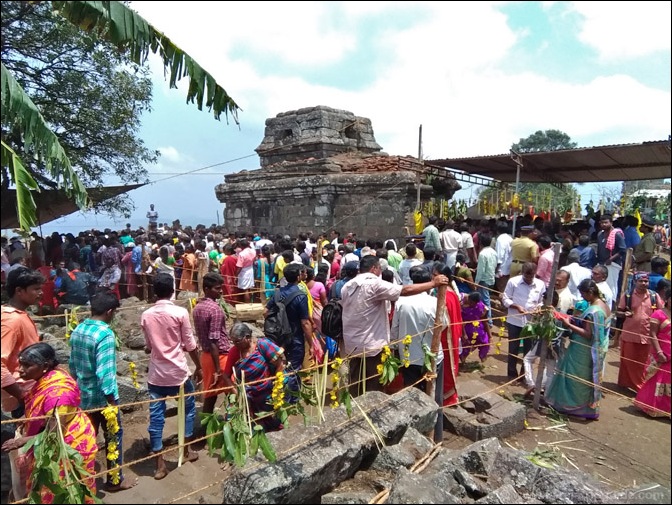
Mangala Devi Kannagi temple is located on a mountain in the buffer zone of Periyar tiger reserve. It is at a distance of 10KM from the Kumily town, Idukki district in Kerala and at a distance of 7KM from Pazhiyankudi, near Lower Camp, Theni district in Tamil Nadu. Trekking is possible from both these places, but jeep access is only available from Kumily town.
Since the temple is located in Periyar tiger reserve, access to the place is restricted. The access to the temple is open to everyone on just one day of the year, the Chithra Pournami festival day of the year. Chithra Pournami is observed on the full moon day of the Tamil calendar month of Chithirai (Medam in Kerala calendar) occurring sometime in April or May. This yearly annual Pilgrimage trek (or jeep trip) is organized jointly by Kerala and Tamil Nadu governments.
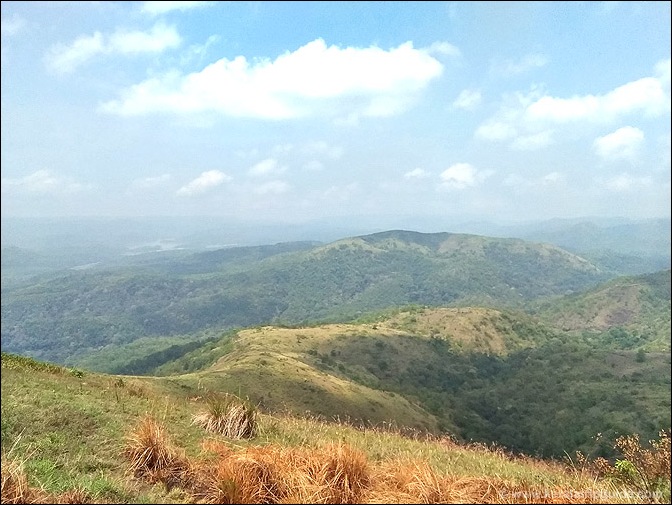
The trek to Mangala Devi offers beautiful view of the Kumily town, Western ghats mountain range and the valleys of the Theni district. You can also see the northern sections of the Periyar lake in Thekkady. The area is a rich habitat of animals, but chances of encountering one during the pilgrim trek is very low. The trek is a treat to the nature lover.
Historical Background – Legend of Kannagi
South Indian language of Tamil is one of the oldest surviving languages of the world. Its earlier forms is considered to be over 4500 years old! According to Tamil literary tradition, there are five great epics of Tamil literature. The oldest one among these is known as the Silappathikaram (The Tale of an Anklet) believed to be composed around the period of AD 100 to AD 400. Silappathikaram is an epic poem containing the story of a brave chaste woman Kannagi, who burnt down an entire town to avenge the death of her husband.
Silappathikaram is the story of Kovalan & Kannagi. Kovalan was a wealthy merchant who married Kannagi. Later Kovalan left his wife for a dancer named Madhavi and spent all his money with her. Kovalan realized his mistake later and returned to his wife. Kovalan and Kannagi decided to start their new life in Madurai. Kovalan tried to sell the precious anklet of Kannagi, but the anklet was mistaken for the stolen anklet of the Queen. Kovalan was accused of the theft and he was beheaded without a trial on the orders of the King Nedunchezhiyan.
Kannagi, furious on hearing her husband’s death, stormed the King’s court. She broke open her other anklet to show that it contained rubies. Thus she proved the the anklet that Kovalan carried is not the same as the stolen one (Queen’s anklet contained pearls). King Nedunchezhiyan realizes that he killed an innocent man. He dies due to heart attack and the queen faints in the court. Still angry, Kannagi sets fire to the palace curtains, which in turn burns down the city of Madurai.
It is interesting to note that Silappathikaram written almost 2000 years ago proposes that even the mighty king is not above the law.
According to legends, Kannagi walked for 14 days to reach near Kumily in Kerala where the temple is now located. It is said that she was reunited with her husband Kovalan and ascended to heavens. The tribal men who saw the event reported it to the Chera King Senguttuvan. As per the stories, Senguttuvan brought stones from Himalayas to build a temple for Kannagi (Mangala Devi). There are also legends that Ilango Adigal, the Jain author of Silapathikaram was Senguttuvan’s younger brother!
Kannagi is considered as a Goddess in many parts of South India. She is also considered as an incarnation of Goddess Bhadrakali in Kerala. Kodungallur Bhagavathy temple and Attukal Devi temple in Kerala are based on the legend of Kannagi.
The Mangala Devi temple structure is built using rectangular shaped granite stones in stacked form. Clearly a lot of human effort was required to bring these giant stones on top of the mountain. The temple construction is in line with that of Pandyan architecture, however, there are no historic records on the origin of the temple. The temple has multiple stone structures which houses idols of Mangala Devi, Karuppaswamy, Shiva and Ganapathy. Since the Mangala Devi temple is in ruins, the idol is usually brought from Cumbum. During the Chithra Pournami, priests from Kerala and Tamil Nadu perform pujas at the temple.
The temple currently is in ruins and is under the protection of archeological department. There are inscriptions on the temple referring to the south Indian emperor, Rajaraja Chola of 11th century. There is considerable political pressure to renovate the temple, however, its location inside the ecologically sensitive Periyar tiger reserve has so far prevented it.
Annual Pilgrimage to Mangala Devi Kannagi Temple
Every year an annual Pilgrimage to Mangala Devi Kannagi Temple is jointly organized by Kerala and Tamil Nadu governments. Facilities for devotees are provided by Mangaladevi Kannagi Trust in Cumbum, Theni and Kannagi Trust in Idukki, Kerala. This Pilgrimage is conducted on the Chithra Pournami day which is the full moon day of the Tamil Chithirai month. This usually is in April or May month of the year. Following are some of the upcoming Chithra Pournami dates,
- 19th April 2019
- 7th May 2020
- 27th April 2021
- 16th April 2022
- 5th May 2023
The following map shows the location of Mangala Devi temple and various routes to reach the mountain top.

There are 3 options to reach Mangala Devi Kannagi temple,
- Trek from Kumily town in Kerala to Kannagi temple. You will trek through the forest covering about 10KM to reach the mountain top.
- Take a jeep from Kumily town. You need to stand in a queue and take a vehicle pass by paying Rs. 90 per person. The distance through the jeep road is around 11KM.
- Trek from the Pazhiyankudi village near Lower camp in Tamil Nadu. You will trek through the shola grasslands covering around 7KM to reach the mountain top. I suggest this route to avoid jeeps and dust. If you are going from Kerala, take a bus to Lower camp from Tamil Nadu check post at Kumily and then take another bus from Lower camp to the village.
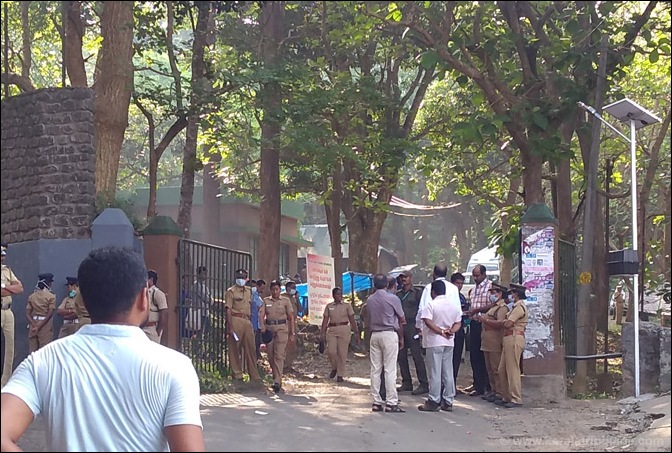
On the festival day, the gates to the road are open from 6AM to 5PM. Trekkers can simply walk through the gate towards the temple. Usually there are two checkpoints, first one for checking whether you are carrying any plastics. At the second checkpoint, you need to walk through a metal detector and you will be manually frisked for any weapons. Police and forest guards are stationed along the trekking route.
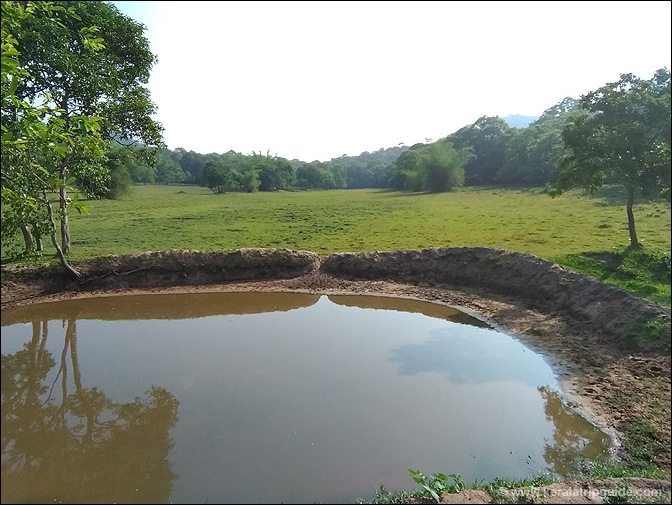
The initial trek route from Kumily is adjacent to the Periyar tiger reserve tourist zone and offers beautiful views. You will also come across artificial water ponds created for animals.

Soon the terrain changes and you will start climbing through thick forest. Plenty of drinking water pipes are available along the way. Beware of jeep drivers who resort to rash driving to complete as many trips as possible. I recommend walking outside the road wherever possible.
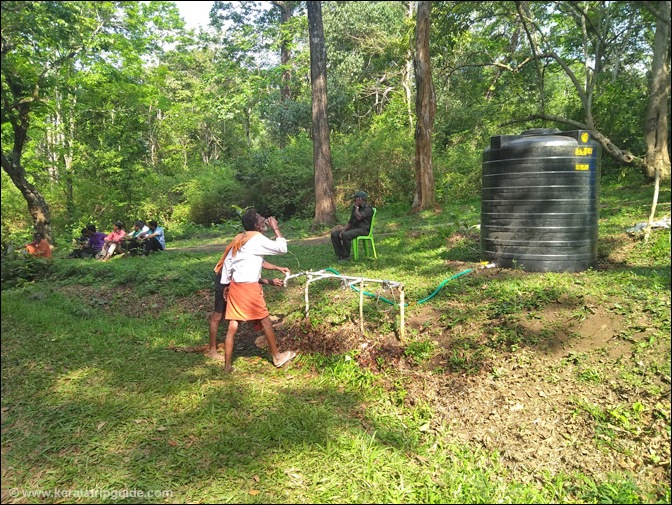
After about 6KM or so you will come across a number of hairpin bends along the way and here trekkers are not allowed to take shortcuts. From here onwards there isn’t much shade and a hat would be useful.
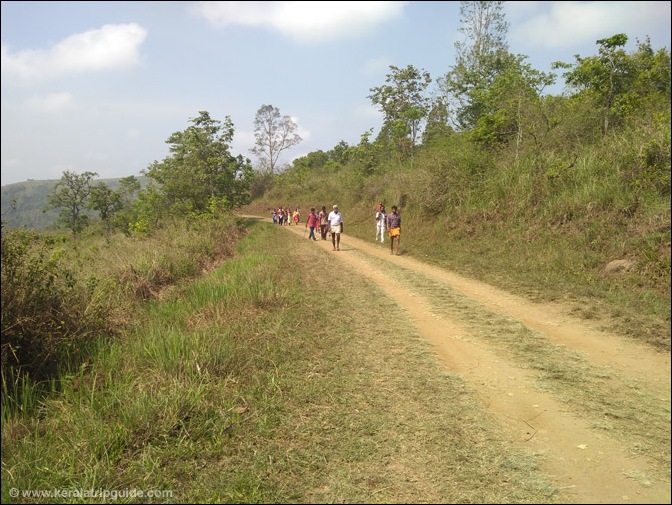
Finally you will reach the shola grasslands area where trekkers are allowed to ditch the road and directly climb the mountain. In the last stretch, a winding road takes you to the top of the mountain where the temple is located. The temple overlooks the Cumbum valley of Theni district. Most parts of the Periyar tiger reserve is visible from the mountain top.
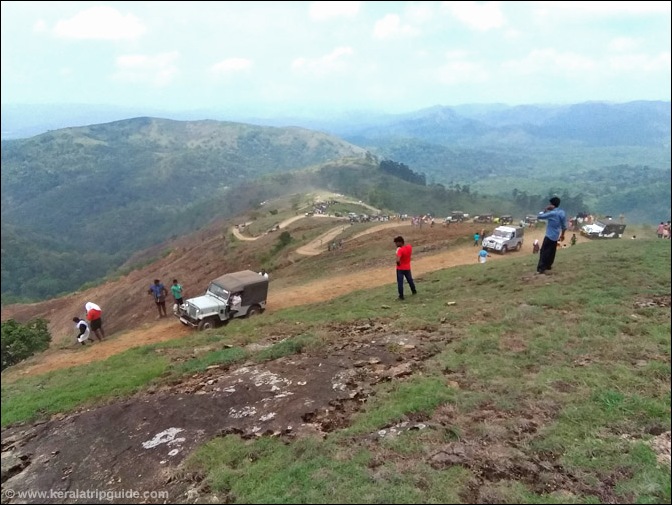
The trail here merges with the trekking path from Tamil Nadu. A steep climb to the right takes you to the entrance of the temple. A giant watch tower is also located here. However, this is not open to the public.
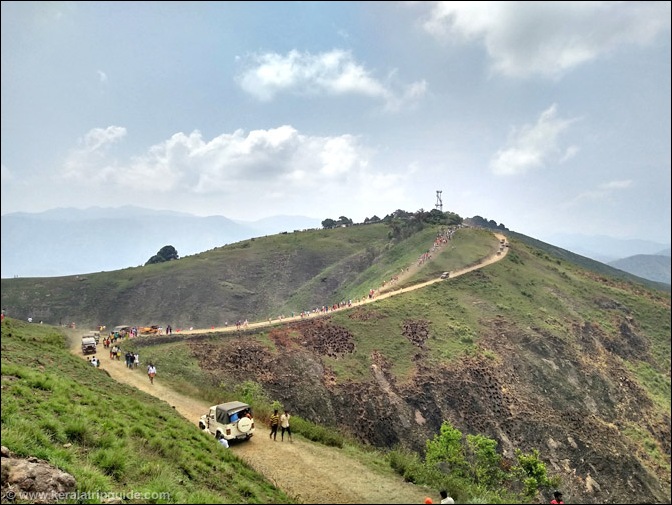
There are multiple stone structures inside the temple complex. The entry to the temple is through a narrow path to the right. There is also a large forest patch behind the temple providing some shade to the tired devotees.
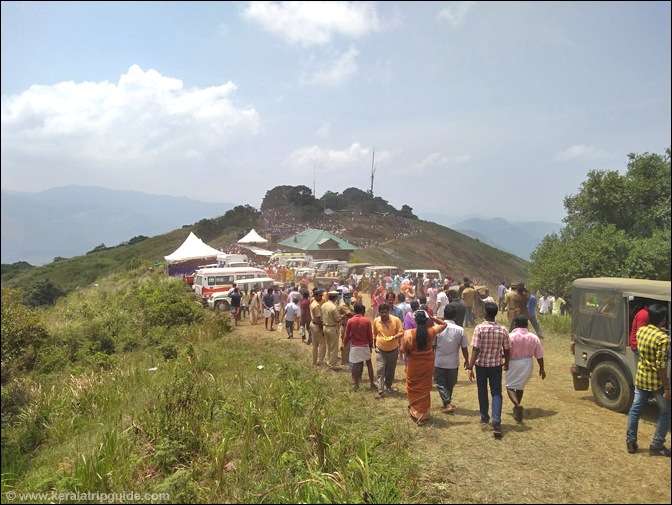
Here are some statistics from the previous Chithra Pournami festivals at Mangala Devi temple,
- In 2017 there were 15,000 devotees visited the place and 516 vehicles conducted around 900 trips to the temple
- In 2018 there were 18,000 devotees visited the place and 553 vehicles conducted around 1200 trips to the temple
Mangala Devi Temple Trek Report – 2018
I have been hearing a lot about Mangala Devi temple trek from a number of Facebook travel groups. My uncle had gone there in 2017 and he was interested in visiting the place again. With my cousins and brother we formed a team of 5 and decided to trek to Mangala Devi temple from Kumily on 30th April 2018. Since we were coming from different places, we decided to spend the previous night in Thekkady.
I explored a number of stay options in Kumily and finally decided to take two rooms in KTDC Periyar House located in the tourism zone of Periyar Tiger Reserve. What a good thing it turned out! The place is buzzing with wildlife. They have a very nice kid’s park and plenty of space to walk around. The only important thing to keep in mind is that no entry is allowed after 6pm!
The package we took had free dinner and breakfast and hence we decided to start our trek after breakfast. We were ready by 8am. The Periyar house is located around 3km from the Mangala Devi road entrance and getting a transport early in the morning from the tiger reserve is not easy. Luckily we got a KSRTC bus which started from Thekkady at 8am going to Changanassery. The conductor of the bus joked that he thought we were heading to somewhere far away such as Trivandrum instead of the Ambadi junction 3km away! When we told our plan of the trek, he was excited and shared his knowledge of the place and the trek. We got down at Ambadi junction and started our trek towards the temple around 8:20am.
Since there is ownership dispute of the temple between Kerala and Tamil Nadu, police was not taking chances. As per media reports, up to 1000 policemen were deployed on the trekking day! There was heavy police presence across Kumily town and at the Mangala Devi entry gate. Medical teams, fire force, forest department and other government departments had their temporary office at the entrance.
There wasn’t any checking at the initial gate. There were sign boards telling us to get rid of plastic bottles and any other plastic stuff. None of us had any luggage and hence we could just walk ahead. We walked for a few minutes and then came across a second security checkpoint with heavy police presence. First any bags were checked for plastic stuff throwing away anything found in luggage. Next we were asked deposit the camera if we are carrying one! I still don’t understand why they are worried about cameras, since mobile phones are allowed. We Indians seems to have some strange fear of cameras. Along the way I noticed that media men and people with “influence” were carrying cameras! After baggage checking we were asking to walk through a metal detector and finally a policeman did the manual frisking of each and everyone!
Thankfully after this checkpoint, things were mostly normal. At some places we encountered power tripping policemen who were not even allowing trekkers to take the footpath barely few meters from the main jeep road. Since jeeps were plying very frequently, there was lot of dust and it was only commonsense to take the parallel footpath. Most of policemen had no problems, but some power hungry ones were unnecessarily forcing people to walk on the main road.
There were plenty of drinking water pipes along the way. We heard from some folks that the water was not available in the early morning. Anyway we had no issues with respect to water. There were over 6 water dispensing stations located around 2km apart along the way.
The initial part of the trek is pretty comfortable with plenty of shade and cool breeze. This area is actually very close and in parallel to the tourism zone of Periyar tiger reserve. We spotted a number of artificial water ponds along the way created for animals during summer.
After walking for around 5km we across hairpin bends along the road. The road was very bad and jeeps had a tough time navigating this stretch and there was plenty of dust. I had to cover my mouth and nose with a handkerchief. After the hairpin bends we could see the temple and the giant watch tower to our right. From this point onwards trekkers could avoid the main road and could climb the mountain directly. While climbing I noticed a trekking path on the left merging with our path on the top of the mountain. This was the trekking path from Tamil Nadu and plenty of people were coming from that side as well. The trekking trail from Tamil Nadu is shorter at a distance of 7KM. After the merge, we walked to the right towards the temple. We could see the beautiful Cumbum valley on the other side of the mountain. I also noticed that people were climbing other nearby smaller mountains on the way back to get a good view of the valley below.
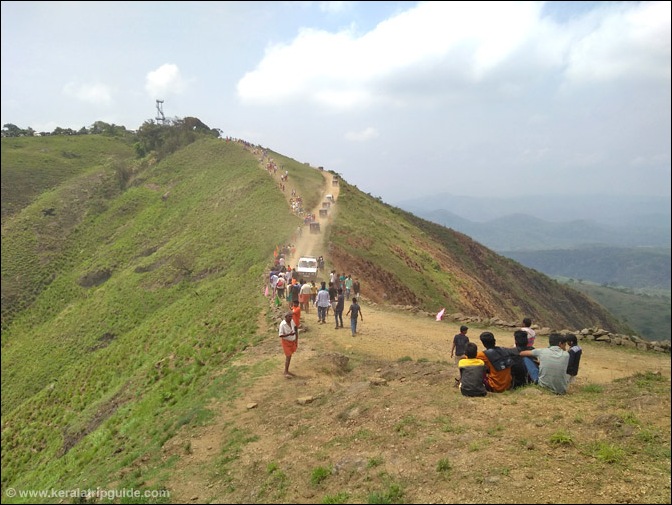
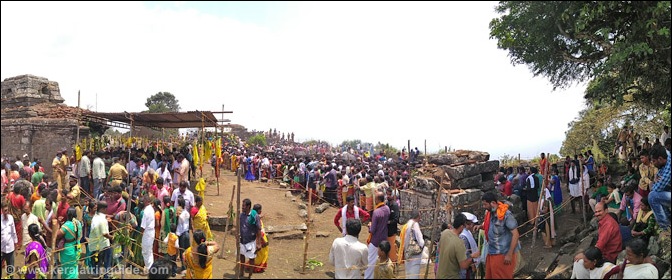
We reached the top around 11am and by this time it was getting very crowded at the top. There was very heavy police presence at the top with most of them resting or sleeping at the shade. There is a large forest patch around the temple, however anyone venturing out to get a shade was asked to go back. Many people were keeping the footwear outside (it was not mandatory) before entering the temple ruins. People were directed to the right side of the temple to enter the temple from the back side. We went around and saw that there was huge rush to get inside the temple. We decided not to enter the temple, but just had a walk around the temple to have a look.
We only had few mangoes with us when we reached top. Thankfully the Kannagi temple trust from Tamil Nadu was distributing free tomato rice to the devotees. We stood in the queue and got tomato rice after few minutes of wrestling. It was delicious!
After spending and hour or so at the top, we decided to walk back towards Kumily. People who came by jeep had a tough time getting a jeep back. Some complained that the police was not helping them to get return jeeps. Many jeep drivers were looking for groups so that they could charge “taxi fee” back instead of the trip fee.
The trek back to the valley was fast and we reached Kumily town around 2:30pm. Luckily the weather during the trek was pleasant with plenty of shade and no rain. When we reached Kumily, we realized that there was heavy rain in the town.
We had food from the Ambadi junction and then took an auto back to Periyar house. We had a quick bath and then went for a walk to the Thekkady boat landing area. We could see a large herd of deer on the other side of the lake. We left Kumily by 6pm.
Mangala Devi Temple Trek Statistics
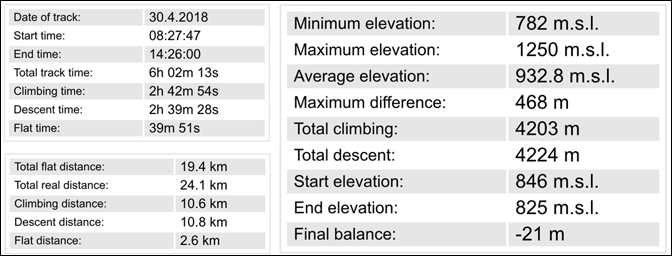
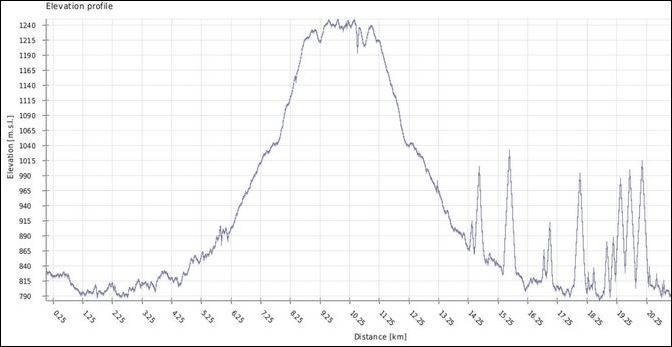
The elevation profile and the trek timing of our trip is given below. The spurious peaks on the right of the elevation profile can be ignored. As per GPS readings, the highest point of trek is at a height of 1250m. The total distance is approximately 20KM and it took us 6 hours to complete the trip.
Mangala Devi Temple Trek Tips
- If you have any kind of dust allergy, do not attempt the Mangala Devi temple trek during the festival from Kerala side. Over 1000 jeep trips are conducted in 12 hours throwing up a large dust cloud along the trek trail (The Tamil Nadu trail is free of dust till the last stretch).
- On the trekking day, start early as possible. If you are coming from a far away place, it is better to reach Kumily one day early and stay in a hotel. I recommend starting the trek at 7AM since this avoids the 6AM rush, but you can still complete the trek before afternoon. During the summer months, there is a strong chance of rain and lightning after 2PM.
- Minimize luggage. Avoid carrying any sort of plastic material as it may get confiscated by the forest guards. Do not carry a DSLR, since due to some strange reason they don’t allow DSLR cameras. However, you can carry your mobile. You can also carry a non disposable water bottle. Plenty of drinking water pipes are available along the way.
- You can carry your own lunch (no plastic covers). However, the Kannagi temple trust offers free food (tomato rice) at the top. If you don’t mind standing in a queue and pushing people to get food, you can choose this instead of carrying your own lunch.
- Carry a pollution mask or a good handkerchief to protect against the dust.
- If you don’t mind taking a bus back to Kumily, return through the Tamil Nadu trekking trail to the lower camp (Kumily town is around 5KM from here). This offers a different trekking experience on the way back.
Mangala Devi Trek Summary
The annual Mangala Devi Kannagi temple festival on Chithra Pournami offers a rare opportunity to experience the beauty of the Periyar tiger reserve and Cumbum valley. It also offers you glimpse into the south Indian history. If you are having any kind of dust allergy, attempt the trek only from the Tamil Nadu side.
Additional Resources
Cheraman Juma Masjid (Cheraman Mosque)
Introduction
Cheraman Juma Masjid
Cheraman Juma Masjid is an old mosque located in Kodungallur taluk of Thrissur district in Kerala. It is considered to be the first mosque in India and one of the oldest mosques in the world. Some believe that the mosque is built as early as AD 629 (very close to origins of Islam)! If true, this would make the mosque one of the important archeological buildings in India.
India and the Arabian Peninsula had trade relations going back to thousands of years. Kodungallur was an active sea based trade route to the Arabian Peninsula. Some believe that the ancient urban centre of Muziris mentioned in ancient texts is located somewhere in Kodungallur. The Cheraman mosque is believed to be built by Malik Deenar, one of the earliest Arabic missionary of Islam. It is probably named after Cheraman Perumal, the Chera ruler of the old Kodungallur kingdom.
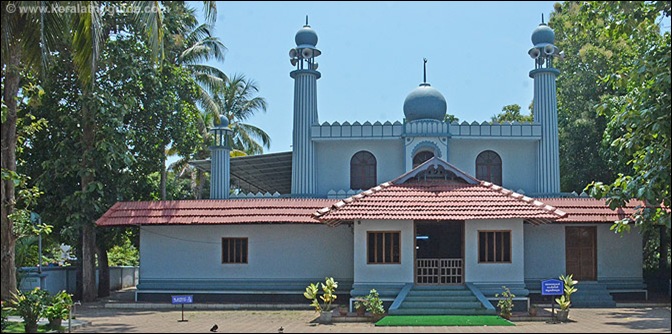
The original mosque was built in traditional Kerala architectural style and it even has a traditional brass lamp and pond seen in most temples of the time. The ancient oil lamp is kept burning and believed to be over a thousand years old. People from all religions bring oil for the lamp as an offering. The lamp and pond is still preserved but the mosque structure had undergone a number of renovations, destroying most of the original style of the structure. Only the front structure has any resemblance to the original structure.
Historical Background of Cheraman Mosque
There is little historical evidence to the origins of Cheraman Mosque. Most of what we know are from the oral traditions. The original mosque had a temple like foundation similar to what is usually seen in 11th century architectural style. It is also quite possible that this structure itself is part of a renovation undertaken sometime in 11th century.
There are a number of stories regarding the construction of the mosque. The most commonly told story is as follows. This story is also featured on the official booklet available for Rs.20 from the Cheraman mosque office,
In sixth century, Cheraman Perumal was the Chera king ruling parts of central Kerala with Kodungallur as the capital. One day he saw an unusual dream of the moon splitting into two at the horizon. No one among the royal astrologers could give a reasonable explanation for the dream. He mentioned the dream to a group of Arabic sailors going to Ceylon. They explained that what he saw could be the miracle that the Prophet Muhammad performed in Saudi Arabia. Cheraman Perumal was convinced about this interpretation and decided to take a trip to Mecca. There he met the prophet and embraced Islam.
Cheraman Perumal spent sometime in Mecca and fell ill and died in Oman. Before his death, he is said have written letters to his caretakers back at home. It is said that Arabic Islamic missionary, Malik Deenar and his companions carried these letters to Kodungallur. They were given permission by the local rules to build mosques around Kodungallur. The first mosque in India was thus constructed at Kodungallur in AD 629 and Malik Deenar himself was the first Ghazi of this Cheraman Juma Masjid. It is believed that later his son (or relative?) Habib Bin Malik became the Ghazi of the mosque. Many believe that the old tombs now at Cheraman Mosque belong to Habib Bin Malik and his wife Khumarriah.
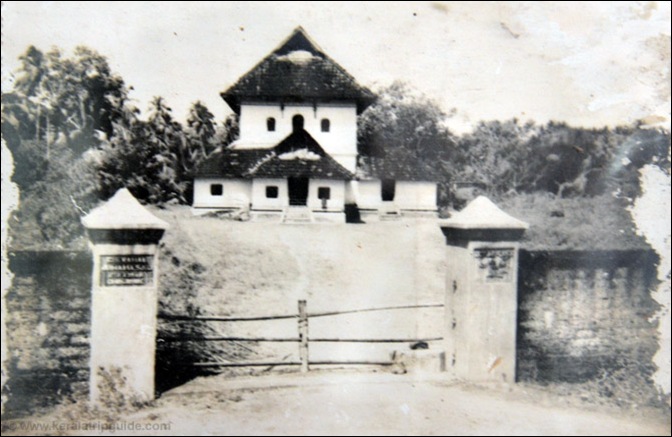
Since then the Cheraman mosque has undergone a number of renovations. It is believed that major renovations were done in 11th, 14th and 15th century. The recent renovations was done in 1974, 1984, 1994 and 2001. The minarets in the current structure was added sometime in 1984 (which has drastically changed the style of the mosque).The front part of the mosque with its wood roofing is relatively untouched during renovations. Following is an old photograph of the mosque taken before 1950.
President A. P. J. Abdul Kalam visited the mosque in 2005. In April 2016, Prime Minister Narendra Modi gifted a gold-plated replica of the Cheraman Juma Masjid to the Saudi King Salman bin Abdulaziz Al Saud.
The Masjid traditionally has welcomed people of all faiths and non-Muslim communities participate in the Iftar offerings during the month of Ramzan. It is a testament to the secular credentials of the area that even non-muslims conduct Vidhyarambham (traditional Hindu initiation ceremony to the world of letters) of children at the mosque.
Details of Cheraman Mosque
Cheraman mosque was designed and constructed based on the traditional Hindu architectural style of Kerala. Mosques all over the world usually face the direction of Mecca in Saudi Arabia, but Cheraman mosque faces east following the Hindu temple tradition. The main section of the mosque (located at the rear of the structure) consists of the Mihrab (people offer prayer facing this wall), Minbar (the raised platform from where imam delivers sermons) and a large traditional brass lamp hanging from the ceiling with inscriptions in Malayalam and Arabic. The Minbar is made of rosewood and has multiple steps and is covered in wooden structures with intricate carvings. The Mihrab has a semi-circular arch with white, blue and golden colors. There are ancient wall writings and beautiful wood work inside the mosque.
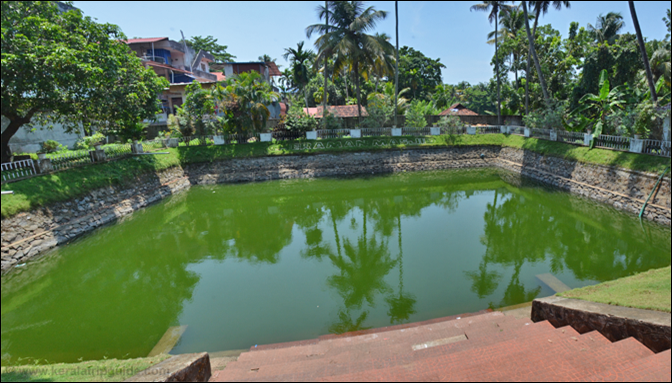
There is large pond behind the mosque again underlying its construction based on ancient Kerala traditions. This pond is currently used for water conservation in the area. The mosque also has a large population of native pigeons.
Getting to Cheraman Mosque
Cheraman mosque is located on the Kerala state highway 51 which connects Kodungallur to Kodakara. The nearest railway station is Irinjalakkuda (20KM), but only a few trains stop there. The major nearby railway stations are Angamaly (27KM) and Aluva (26KM). The nearest airport is Nedumbassery (Cochin Airport) located around 25KM away.
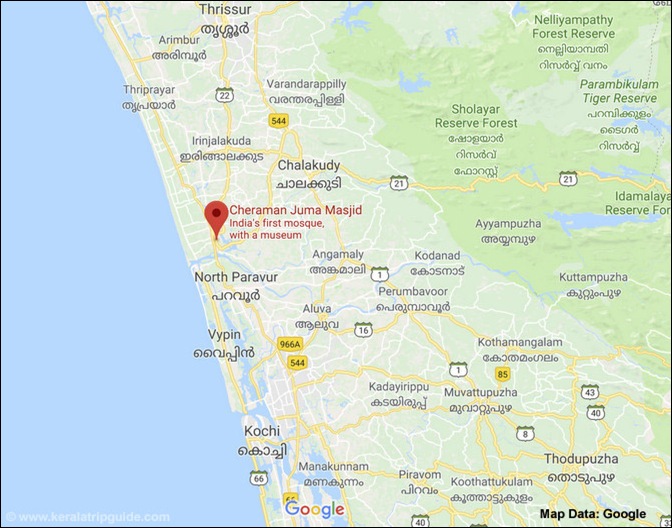
If you are visiting the place by bus, you can take a KSRTC bus to Kodungallur and then take a local bus to the mosque. Since the place is close to Kodungallur (2KM) you can also take an autorickshaw from the Kodungallur town. If you plan to stay to explore other areas such as the Muziris Heritage Project, good hotels are available near Kodungallur town.
Visitor’s Guide to Cheraman Mosque
Park your car at the paid parking lot near the Islamic history museum. It is large and if you are lucky, you will be able to find a parking area with some shade. After paying the parking fee, proceed to the Islamic history museum. There is a small entry fee (Rs.5) to the museum. The museum is very small with some historical artifacts and probably the only significant item is the large replica of the original Cheraman mosque. You can easily spend half an hour here exploring various exhibits. After the museum visit, proceed to the mosque pond by going around the museum. A modern, well maintained toilet complex is located on the left of the footpath (behind the museum) leading to the mosque pond. After visiting the pond, walk toward the front of the mosque complex.
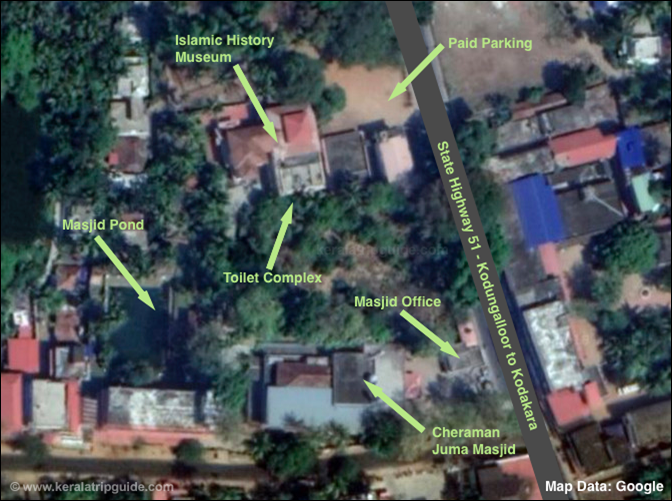
The mosque office is located adjacent to the main road. If you are planning to take photos inside the mosque, please visit the office and take permission. You can also get an official booklet on the Cheraman Masjid from the office for Rs.20. The front door to the mosque is usually locked. To see the hanging lamp and the main structure, go to the right side of the mosque (Please note that this area is not open for women). Clean your legs with the water from the tank and then proceed to the main mosque area.
Islamic History Museum at Cheraman Mosque
There is a small museum on the northern side of the Cheraman Juma Masjid. They charge an entry fee of Rs.5 to the museum which is just one small room. This museum is now known as Islamic history museum probably renamed as part of the Muziris Heritage Project. The official opening hours are from 10AM to 5PM (the mosque office is open from 8:30AM to 7:30PM).
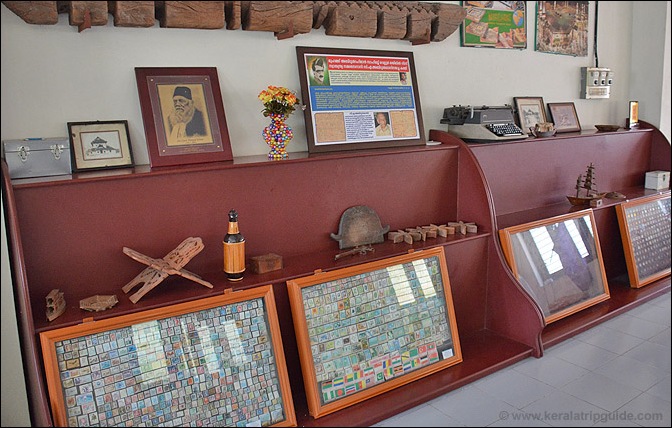
There are only a handful of interesting historic artifacts here. Many things in the collection such as the stamps have little historic significance as far as the mosque is concerned. The main attraction is the large size replica of the Cheraman Juma Masjid before the minarets were added to the structure. There are also a couple of photos of the old mosque, an old gramophone, a giant set of old keys and some news clippings.
My Visit to Cheraman Mosque
I had gone to the Cheraman mosque on a Monday during summer. Since Monday is holiday for the Muziris heritage project and museums, no tourists were at the mosque or the museum nearby. I reached the mosque around 1pm. After parking, I found the museum to be closed. When I asked the security, he called the caretaker handing him the keys to the museum. I spent around half hour in the museum and I was the only visitor at the time. There were only few items with any historic value. I saw a audio visual kiosk which was switched off. Later a bus with a large group of religious tourists came to the place. It was getting crowded at the museum and hence I proceeded to the Cheraman mosque.
I went around the museum toward the mosque pond. After spending few minutes at the pond I walked towards the front of the mosque. There was a large group of pigeons in front of the mosque and the security staff stationed there was feeding it. I asked him whether I can take photos and he told me that I need permission from the office to take photos inside the mosque. When I asked the guy at the office he told me that his boss is not there to give the permission. I left the place after visiting the mosque and taking a few photographs of the outside structure. Following is the cover of the information booklet available at the mosque,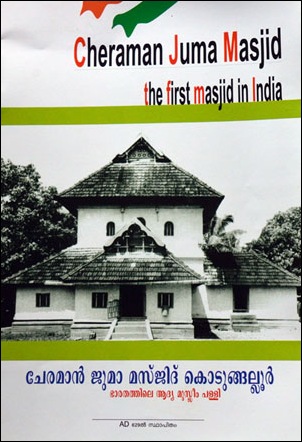
Summary
Cheraman Juma Masjid is probably the second oldest mosque in the world. If you are in Kerala as a tourist and if history is something that excites you, don’t miss the ancient Cheraman Juma Masjid in Kodungallur. Spend an hour here and marvel at the fact that the world’s second largest religion started its journey in India from this small place around 1400 years ago!
There are a number of interesting historic places near Cheraman Juma Masjid. These include Cheraman Parambu, Muziris boat jetty, Munambam beach, Munakkal beach, Kottappuram fort (also known as Muziris fort or Kodungallur fort), Kodungallur Bhagavathy Temple, Marthoma Church, Maliankara bridge and a number of interesting museums such as Kerala Jews history museum, Paliam Palace museum, Paliam Nalukettu museum, Sahodaran Ayyappan museum, Abdul Rahman Sahib museum and Kesari Balakrishna museum. For more details about these places, please visit the Muziris Heritage Project website.
Additional Resources
Padmanabhapuram Palace
Important Note: This article is a summary of my experience in 2017. Current details of the event/location may be different from what is mentioned in the article.
Introduction
Padmanabhapuram Palace
Padmanabhapuram Palace is an old wood Palace of Travancore kings located in Padmanabhapuram municipality of Kanyakumari district, Tamil Nadu. It is actually a palace complex consisting of 14 palace buildings and covers an area of 6.5 acres. The palace complex sits at the centre of Padmanabhapuram fort covering an approximate area of 186 acres. The palace is located at the foot of the Veli hills (Velimalai) and the river Valli (Valliyar) flows nearby. Even though Padmanabhapuram Palace is located in Tamil Nadu, the palace is under the administrative control of archeology department of Kerala government.
Padmanabhapuram Palace is an exceptional example of traditional Kerala building techniques and craftsmanship in wood work. It is the largest well preserved specimen of traditional Kerala architecture. It is also home to a large collection of excellent murals depicting Hindu mythology and secular themes. Due to its uniqueness and historical importance, Padmanabhapuram palace is added to the UNESCO’s tentative list of world heritage sites.
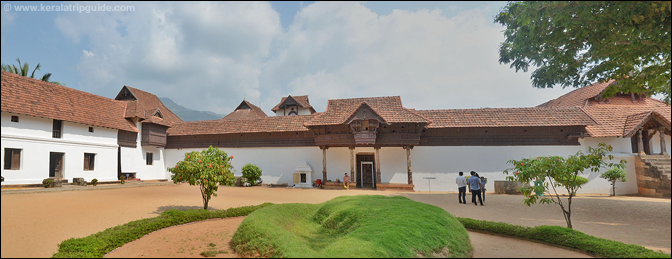
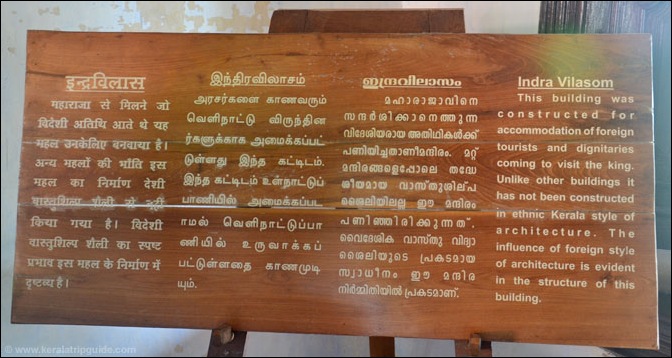
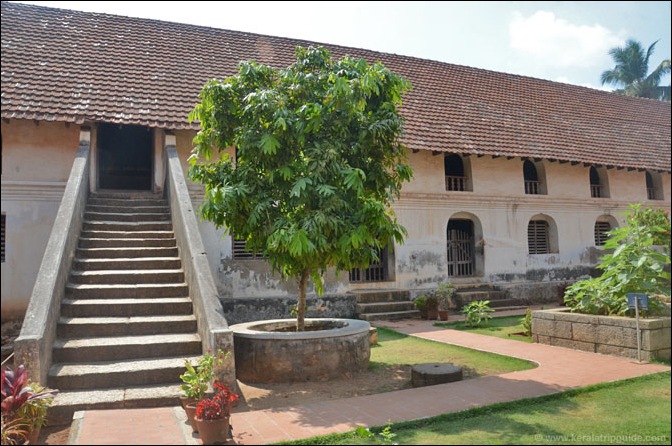
Padmanabhapuram Palace complex consists of 14 primary structures. The major structures include Padippura (main gate leading to poomukham), Poomukham(reception hall), Plamootil Kottaram (living quarters), Veppinmoodu Kottaram(living quarters), Thai Kottaram(mother palace), Uttupura (kitchen and dining hall), Homappura (rituals and prayer hall), Uppirikka Malika (sacred palace), Ayudhappura (armory house), Chandravilasam(entertainment hall), Indravilasam(entertainment hall) , Navarathri Mandapam(dance hall), Lekshmi Vilasam (palace) and Thekke Kottaram (palace).
History of Padmanabhapuram Palace
Padmanabhapuram Palace was the citadel of Travancore (thiruvithamkoor) kingdom from AD 1550 to 1795. A mud fort was constructed around the palace sometime in 1600. Originally the palace was known as Kalkulam palace. In 1729, Marthanda Varma became the Travancore king and he rapidly extended his kingdom all the way up to Ernakulam. He also started construction activities across the state. Under his command, The Kalkulam mud fort was demolished and a granite fort was built. The Kalkulam Palace inside the fort was also rebuilt around 1750. Marthanda Varma dedicated his kingdom to Lord Vishnu (Padmanabha) and the Kalkulam palace was renamed to Padmanabhapuram Palace. In 1795, the capital of Travancore was shifted from here to Thiruvananthapuram.

Getting to Padmanabhapuram Palace
Padmanabhapuram Palace is located around 2KM from the Trivandrum-Kanyakumari National Highway (NH66) at Thuckalay town. It located around 50km from Trivandrum city, 12km from Nagercoil and around 35km from Kanyakumari town. The national highway along this stretch is one of the busiest in the country and traffic jams are common. If you are driving from Trivandrum, it may take up to 3 hours to reach Padmanabhapuram palace.
The nearest railway station is Eraniel which is located about 5km from the palace. You can take an auto from the railway station. Please note that not all trains stop at Eraniel and the next major station is at Nagercoil (12km). If you are driving from Trivandrum, check out the route map given below.
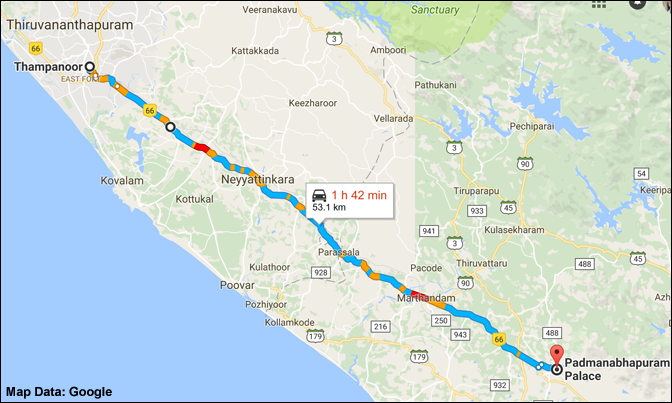
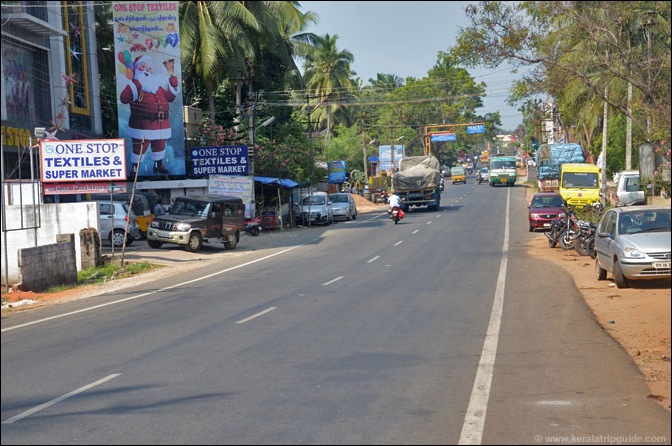
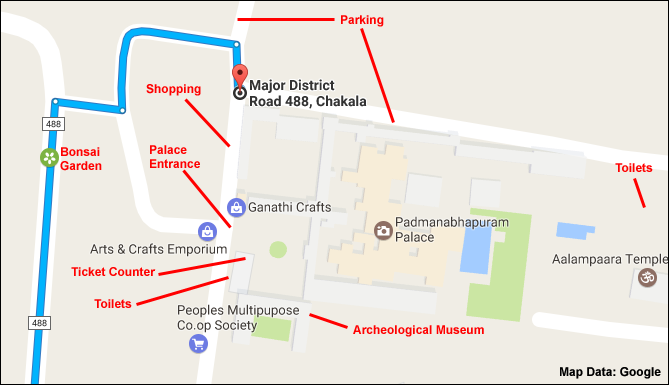
If you are driving from Trivandrum, you need to take a left from NH66 just before Thuckalay town. Direction board to the palace is on the main road, but it is easy to miss it. Drive along this road (MDR488) for about 1.5km and you will find a Bonsai Garden on the left. Immediately after the garden take a right turn. At the next junction you will have to pay the parking fee of Rs.50. Parking space is available on the northern side of the palace. After parking you need to walk around 100m to reach the entrance of the Padmanabhapuram Palace. Refer to the location map below for details.
Padmanabhapuram Palace General Information
| Location | Kalkulam village, Kalkulam Taluk, Kanyakumari District, Tamil Nadu, 629175 |
| Area | 6.5 Acres |
| Distance | 50km from Trivandrum City |
| Nearest Railway Station | Eraniel |
| Nearest Bus Station | Thuckalay |
| Nearest Airport | Thiruvananthapuram |
| Timings | 9AM – 4:30PM – Tuesday to Sunday |
| Holidays | Monday and National Holidays |
| Ticket Rates | Parking fee – Rs. 50 Indians – Adults: Rs.35, Children: Rs. 10 Foreigners – Adults: Rs.300, Children: Rs.100 Camera – Rs.50 (Rs. 2000 for professional video) |
Padmanabhapuram Palace Visit
I visited Padmanabhapuram palace during my trip to Kanyakumari. Since it was a weekday, there wasn’t much crowd in the palace. Weekends are usually very crowded and is not a good time to explore the palace. Padmanabhapuram Palace is a place you should explore in a leisurely pace.
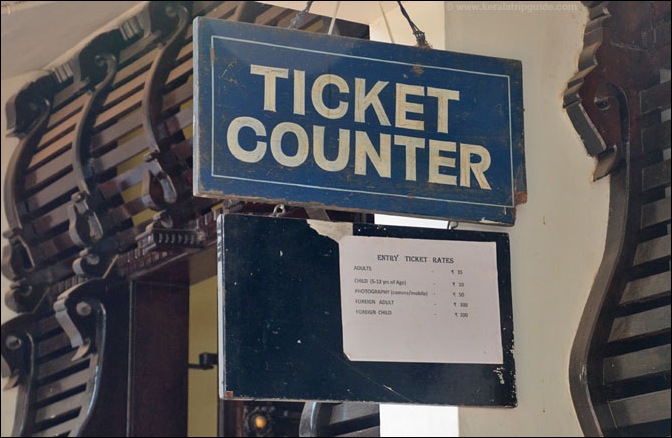
We reached the palace around 10AM on a Wednesday and there was little crowd at the ticket counter. A detailed guide book on the palace is available at the ticket counter. Published by department of archeology, It is priced at Rs.100 and is available in various languages (Malayalam, English and Tamil). I recommend that you buy a copy of this book and refer to it as you walk around the palace.
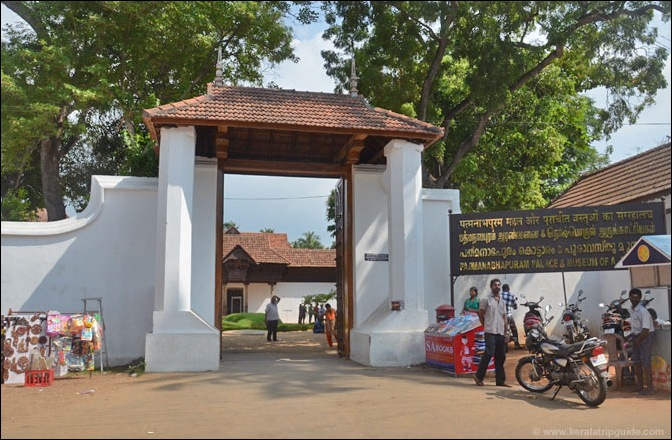
A giant door (Padippura) leads to the palace complex. There is security check at this entrance and they check your tickets and your bags. The Kerala government officials on duty was helpful and courteous. The first major structure you see after entering the palace complex is the Poomukham (reception hall). There is an interesting hanging lamp known as Kuthira Vilakku at the center of the reception hall (see gallery) .
Archeology department employs a number of guides at the palace. They are located at all main structures in the palace. They are supposed to help tourists in understanding the palace structure and history. Since many local tourists come here on a picnic, they only interact if you show interest in knowing more. There are also detailed description boards displayed near all major attractions. There is a well defined walking path with direction boards across the palace and you just need to follow along to visit all places. I think it will take 3 to 4 hours to see the entire palace if you are interested in the items displayed inside. Hence the best time to visit the palace would be around 9am or 1pm.
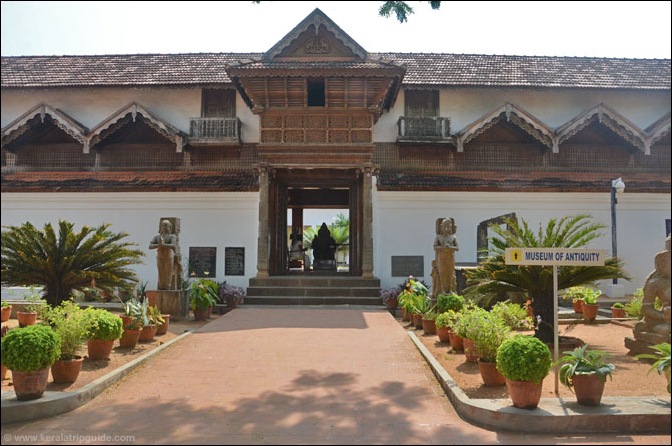
As you walk around the huge palace, you get an idea how Travancore kings lived and the facilities they had in the palace. Some of the areas such as the prayer room and storage room is not accessible to the public. There are multiple buildings and most of them are connected by narrow tunnel like wood structures. The soothing lighting and excellent air circulation is a relaxing feature of the palace and it is cool inside even during the peak summer.
Some of the interesting attractions of the palace are,
- Wood carvings on the ceiling – There are exquisite and detailed wood carvings at many areas of the palace.
- Manimalika (Clock tower) – A working clock which is believed to be over 200 years old. The clock bell can be heard over a radius of 3km.
- Uttupura (Dining hall) – A large dining hall which can accommodate up to 2000 people.
- Mural Paintings – There are a number of 18th century mural paintings which depicts scenes from puranas and the lives of the people in Travancore state.
- Navarathri Mandapam – Navarathri mandapam was built for cultural performances and consists of a large number of sculptured granite pillars.
The guest quarters of the palace is located on the rear of the palace and is built on the western architecture. Compared to the other palace structures, this building is very spacious. The southern side of this building opens to a large garden and the main road is visible from the north side.
You can see the mountains of the western ghats (Veli hills) from the palace. These mountains probably provided additional protection to palace in ancient times.
Padmanabhapuram Palace Archeological Museum
There is an archeological museum on the southwest corner of the palace constructed by the department of archeology. This was completed around 1993. It has a fairly decent collection of archeological findings from the southern part of Kerala. The collection consists of wooden sculptures, stone structures, ancient coins, ancient weapons and copies of mural paintings. There are also some exhibits from the Indus Valley excavation. A scary exhibit here is the iron cage used to lock up criminals in the Travancore state (see gallery). These cages were hung on trees and the victims had a slow death due to starvation and vultures.
Summary
Padmanabhapuram Palace is an excellent destination to spend half a day exploring the history of Travancore state and the brilliant work of top craftsmen at that time.
Additional Online Resources
Varayattumotta Trek
Important Note: This article is a summary of my experience in 2016. Current details of the event/location may be different from what is mentioned in the article.
Introduction
Varayattumotta Trek
Varayattumotta is a mountain ridge located about 40km from Trivandrum city. It is famous for its small population of Nilgiri Tahr which is an endangered species. In Malayalam, Nilgiri Tahr is known as Varayaadu and the name of the mountain ridge is derived from it. Varayattumotta in all its glory is visible from the Ponmudi mountain, a very popular destination in Trivandrum accessible by car. Kerala forest department allows trekking to this location as part of its eco-tourism activities.
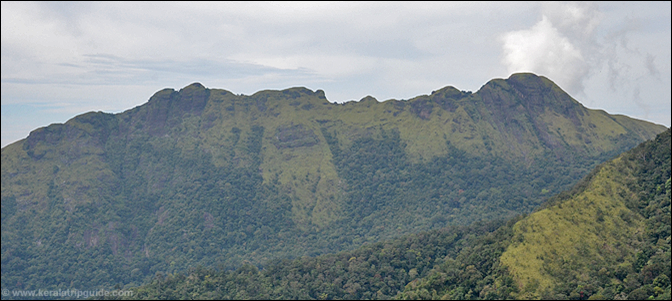
This mountain range also known in various other names such as Varayadumotta, Varayadumudi and Varayattumudi. I have also heard stories that Varayattumotta was originally known as Ponmudi.
Varayattumotta with a peak height of around 1100m is accessible after a trek from Ponmudi check post or from Mankayam check post along the Braemore route. The mountain ridge is very steep except on the northern side and hence is rarely visited by local people. The ridge is a protected site under the Palode reserve forest and prior permission is required for the trekking. The permission can be obtained from the ecotourism units of Mankayam or Ponmudi by paying a fee for the trekking team. A forest guide will accompany the trekking team. Usually trekkers climb the mountain and return to either Mankayam or Ponmudi. It is also possible to cross the entire ridge and reach the Kallar valley along the Ponmudi main road. However this is a much tougher trek trail.
Getting To Varayattumotta
There are 2 main trek routes to reach Varayattumotta. One is from Mankayam check post on the way to Braemore estate. The second route is from Ponmudi check post. Mankayam and Ponmudi are accessible by car and KSRTC bus.
There is only one direct bus to Mankayam starting at 6:30AM from Trivandrum city. This reaches Mankayam check post around 8:30AM. If you are starting the trek from Ponmudi, take the bus to Ponmudi starting at 5:30AM from Trivandrum city. You will reach Ponmudi around 8:15AM. After finishing the trek at Kallar, get a bus to Vithura. From Vithura, there are plenty of buses to Trivandrum city via Nedumangad.
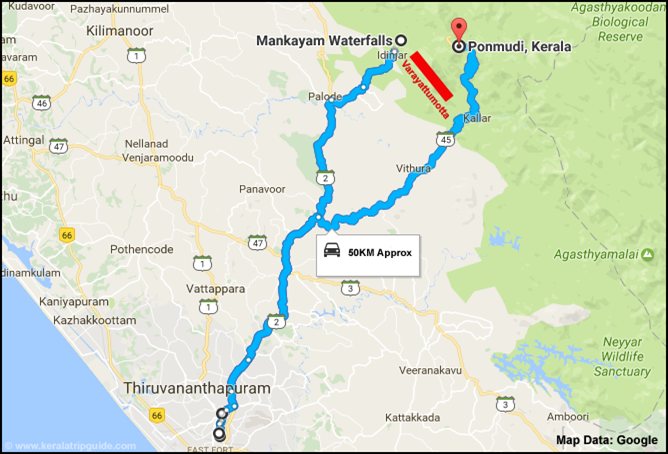
The following trek report is based on our trek from Mankayam to Kallar valley crossing the Varayattumotta ridge. The following map shows our trekking trail. There are no water sources on the main ridge and hence you must have adequate water with you before attempting this 10 hour trek.
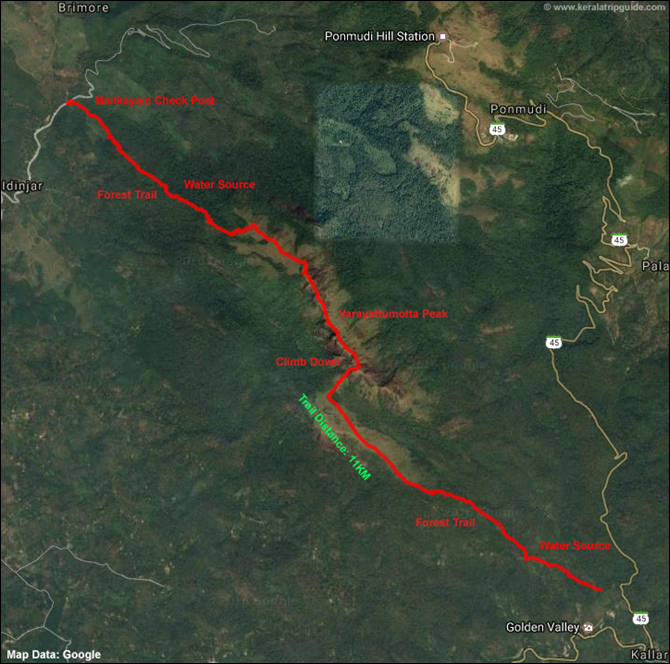
Popular tourist spots around Varayattumotta peak include Ponmudi, Meenmutty waterfalls, Kallar river, Mankayam water falls and Braemore estate.
Varayattumotta Trek Report
Our trekking expedition was organized by a nature club in Trivandrum. We were a group of 8 people from different walks of life. We took the early morning (6:30AM) KSRTC bus from Trivandrum city to Braemore. Just before the Mankayam check post our bus stopped at a small hotel for breakfast.
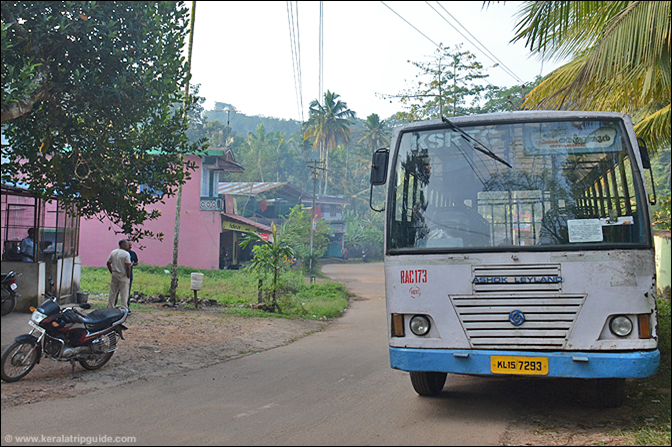
We reached the Mankayam check post around 8:15AM. Our trek leader had brought breakfast and lunch for the entire team. We had our breakfast in the dining hall behind the check post.
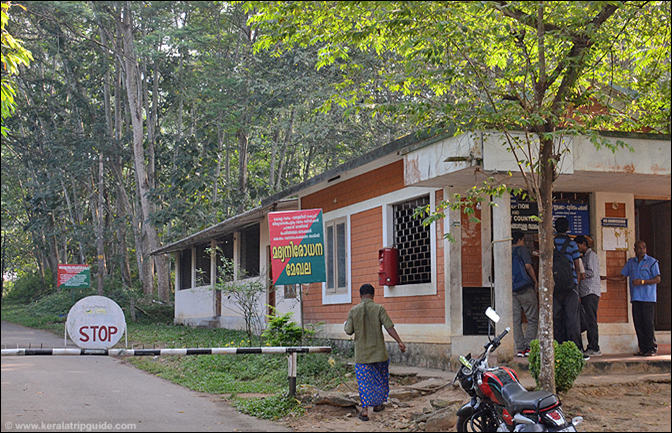
We started our trek from Mankayam check post around 8:45AM. The initial stretch itself was a difficult climb through a bamboo forest. Climbing immediately after a heavy breakfast wasn’t a bright idea. Luckily after the initial climb, the terrain alternated between steep climb and flat terrain. About an hour into our trek we came across a herd of elephants on the right side of our trail. Our guide was very careful and he helped us to bypass the herd without any incident.
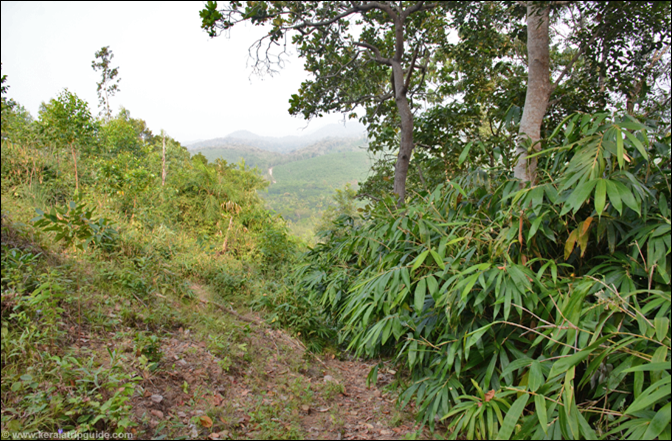
We reached an open area by 11AM after covering a distance of about 3.5km. From here we took a left turn towards another forest trail. By 11:15AM(4km) we reached the last water source on the ridge. Since we knew that there are no water sources for another 8 hours, we filled all our bottles and took a 10 minute break.
It took us another half an hour trek (4.75km) to reach the open base of the Varayattumotta mountain ridge. This location gave us a panoramic view of the Ponmudi mountain. We could see the Ponmudi road ahead of us and the tourists going to the top by car. Finally we could see the mighty Varayattumotta peak on our right side, hiding the rest of the peaks on the ridge.
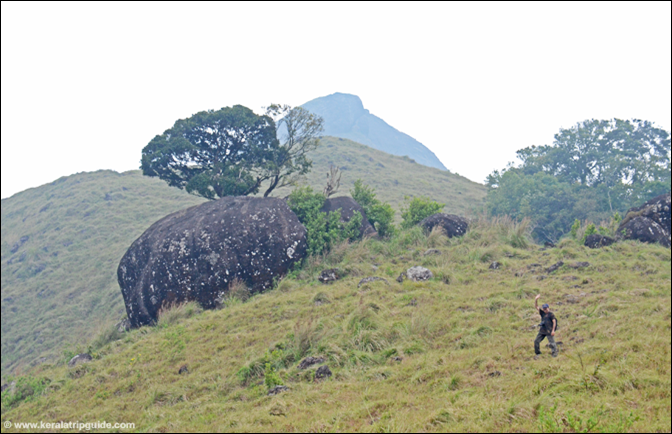
 We continued our climb and It took us while to reach the Varayattumotta peak. The final climb was steep and dangerous. We reached the top around 12:30pm covering a total distance of over 5km. Once you reach the top you realize that it is just the beginning of the trek! The top of the peak is a flat rock surface. The full Varayattumotta mountain ridge is visible only after crossing the second peak. In this ridge, climbing down a peak is much more difficult than climbing up. In some places rocks are extending towards the valley with a small part barely holding it to the mountain! Adventurous ones in our team took photos sitting on them.
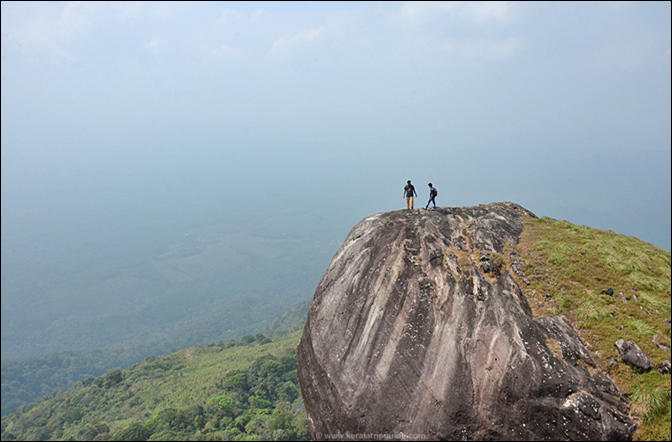
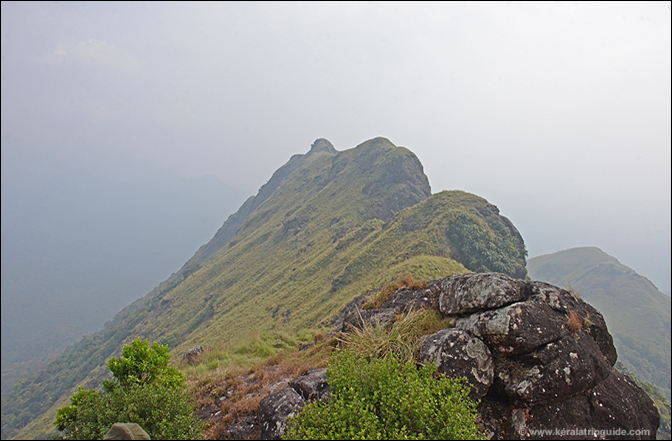
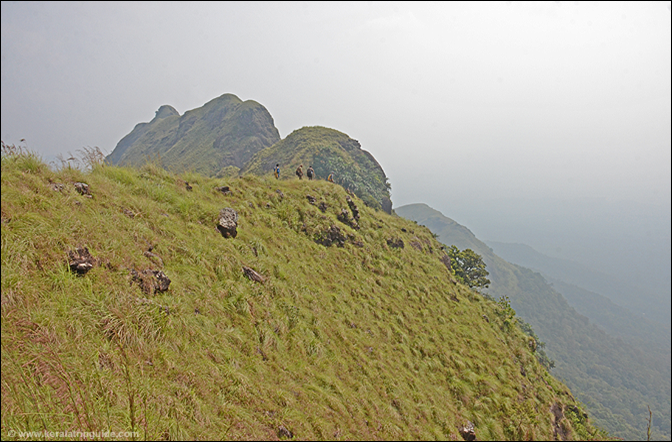
Nilgiri Tahr (Varayadu) in this range is very shy of humans. If you are lucky you may be able to get a glimpse of them running towards the valley as you climb to the top of the peaks. Today was not our lucky day.There are only a couple of trees on the mountain ridge. However on the western slope, there are a number of mini forests. There are also groups of tall palm trees on this slope. Some of the bushes along the trekking trail have long and sharp thorns on them.
We had our lunch on one of the peaks. The sun was relentless and I was now scared of running out of water. We were all very tired and this made climbing down the peaks much more dangerous. A small mistake could mean slipping down to the valley below.
We reached the last peak around 4PM. Just before the last peak there is a narrow path. This is a dangerous path surrounded by tall grass and sharp cliffs on both sides. I was very careful in crossing this stretch as a small mistake could be fatal. The trail to the Kallar valley is just before this last major peak. Most of us were too tired to climb the last peak.
The toughest part of Varayattumotta trek is the climb down from the last peak towards the Kallar valley. It is a dangerous 80 degree slope and the ground is very slippery with gravel and dust. You will have to crawl or slide down to minimize the risk of falling down.
After climbing down we took a left turn from the valley towards Kallar town. This is an open and relatively flat field for about a km or so. The next stretch was through a thick forest and we could see elephant droppings everywhere. It was getting dark, but the rapidly descending and slippery road slowed us down. Finally we reached a motorable dirt road connecting the Ponmudi-Kallar main road. Water was available at this junction. We relaxed here for a few minutes and then walked to the Kallar junction taking a shortcut along the way.
We reached Kallar junction around 7PM, just in time to catch the last bus from Ponmudi going to Vithura. From Vithura, I got a bus to Nedumangad and then to Trivandrum city. I reached home around 10PM.
Statistics – Varayattumotta Trek
The total trek distance is around 11KM and it took us around 10 hours to cover it. The highest point we trekked to is at 1075 metres. Check out the following charts for a detailed look at Varayattumotta trek. Please note that the following charts show the GMT time and if you want to calculate the IST time, just add 5.5 hours.
Varayattumotta Trek Summary Report

Varayattumotta Trek Elevation Distance Profile

Varayattumotta Trek Tips
- Water is not available anywhere on the mountain range. So carry 3 bottles of water with you. Minimize the weight you carry.
- There are plenty of elephants on both sides of the Varayattumotta mountain range. So you need to be always aware of your surroundings. Follow the instructions of the local guide.
- Whenever you are climbing down, be very careful. A small mistake can be deadly. Crawling or sliding down is safer in many places.
- There are bushes with sharp thorns along the mountain range. I had one of them stuck in my thighs causing intense pain.
- Varayattumotta trek is a physically demanding trek. Attempt it only if you are in good shape. Also carry a small packet of glucose to fight hypoglycemia.
- There isn’t much shade along the mountain ridge. So carry a good hat.
Additional Resources
Book Review: The Elements of Computing Systems
I do not fear computers. I fear the lack of them.
– Isaac Asimov
Introduction

Interestingly this is a problem faced even by computer science graduates! This is due to the high level of specialization and separation of computer science topics. Hence even CS graduates miss the elegant big picture of the computing field. The Elements of Computing Systems is a book designed to address this gap. This book attempts to provide a complete high level summary of the computing basics in just about 250 pages! Man, it does a really good job at that!
As you go through each chapter in the book, you are required to build each building block of a computer. You start with the basic Boolean logic gates and then move onto building complex Boolean circuits, Arithmetic & Logic Unit (ALU), CPU, memory modules, machine language, assembler, virtual machine, high level language, compiler and finally even an operating system!
Book Review: The Elements of Computing Systems
The Elements of Computing Systems (also known as Nand2Tetris) is written by two computer science professors, Noam Nisan and Shimon Schocken. It is a self study guide for building a modern computer from first principles. The book’s basic premise is that the best way to understand how computers work is to build one from scratch! The book consists of 13 chapters each containing a project that the reader is supposed to solve. The only pre-requisite for the book is the knowledge of a programming language.
If you study the book and then solve all the programming problems in it, you will get a deep understanding of the following topics,
- Boolean logic and logic design
- Data representation in computers
- Designing memory, ALU and CPU
- Practical use of data structures & algorithms such as stack, list, recursion etc.
- Method call stack, object allocation and heap
- Variable types, scope, object and array representation
- Memory addressing and memory mapped I/O
- How to write an assembler, virtual machine, compiler and operating system!
Obviously building a full fledged computer from basic logic gates is a very complex undertaking. However the authors have simplified this challenge substantially by adopting a number of clever strategies. These strategies ensure that the programming problems doesn’t become too complex for a beginner,
- We use a hardware simulator for building computer hardware. This avoids the need for working with physical components. Yet at the same time this teaches you everything you need to know about hardware!
- This course ignore error handling and optimization problems. For example, when you write a compiler you can assume that the program being compiled is error free. Optimization is an important yet hard problem. Ignoring it makes things simpler.
- The ALU (Arithmetic and Logic Unit) and CPU built as part of this course has a very simple instruction set. For example, the CPU we build won’t have any native multiplication capability. Also it only works with 16-bit integers.
- The assembly language and high level language (Jack) are all a bit verbose. But this substantially reduces the complexity in building assembler, VM code generator and compiler.
- Each chapter contains almost the entire design of what you are building. The design and the hints provided are the keys to the simplicity and the power of this course.
The Elements of Computing Systems consists of 13 chapters contained in about 250 pages. Each chapter starts with a background section, describing relevant concepts. The next section is specification, which provides a clear statement of the system’s abstraction – namely, the various services that is expected to deliver. The chapter then proceeds to discuss how the abstraction can be implemented leading to a proposed implementation section. The next section, perspective, highlights the important issues left out from the chapter. Each chapter ends with a project section, which provides a detailed guide on building and testing the system described in the chapter.
Here is a summary of the chapters,
- Boolean Logic – The book starts with quick introduction to Boolean logic and logic gate circuits. Using the basic Nand gate, a hardware description language (HDL), and a hardware simulator, you will build other logic gates such as And, Or, Xor and Multiplexer. An HDL tutorial is provided in the appendix.
- Boolean Arithmetic –
 Chapter 2 introduces Boolean arithmetic and signed integer representation in computers. You will build logic circuits for adding binary numbers using the chips built in the previous chapter. Finally you will build an arithmetic and logic unit (ALU) capable of doing arithmetic and logical operations.
 - Sequential Logic – Introduces sequential logic and explains why a clock is necessary to maintain state in logic circuits. This chapter assumes flip-flop as the basic building block and then proceeds to show how memory registers can be built. You will build a program counter and memory units as large as 8K.
- Machine Language – Introduces a simple machine language capable of doing computation and memory access. The compute instruction is defined such that it can be implemented using the ALU built in the previous chapter. The machine language is simple and easy to learn and implement.
- Computer Architecture –
 This chapter combines the hardware components and the machine language to build a full fledged computer. You will combine memory, ALU and control chips to build the Hack computer. A keyboard and display is also added using memory mapped I/O. In Hack architecture, instruction memory and data memory are kept separate.
 - Assembler – This chapter take us to the software land. You need to know a high level language to solve the programming problems from this chapter onwards. A simple mnemonic set is defined for the Hack machine language. You will then build an assembler for converting these mnemonics to actual machine language.
- Virtual Machine – I: Stack Arithmetic – Many modern languages (Java, C# etc.) are compiled to an intermediate virtual machine code for portability. This chapter introduces a stack based virtual machine language/architecture. You will need to write a program to convert the VM instructions to the assembly language defined in the previous chapter. This is a complex activity and hence is split into two chapters.
- Virtual Machine – II: Program Control –
 This is a continuation of the previous chapter and you will build the program control part of the virtual machine. Once you have completed the VM to assembly converter, you can write programs with less effort compared to the assembly language.
 - High-Level Language – Introduces a high level language called Jack. It is similar to Java but is more verbose so as to help the compiler writer. Write a number of programs in Jack language to get a feel for it.
- Compiler – I: Syntax Analysis – The next logical step is to write a compiler that can translate the high level Jack code to the virtual machine code. It is a complex project and hence is attempted in two chapters. This chapter introduces the syntax analysis and parsing techniques of compilers. You will write a parser for the Jack program to convert it into a sequence of tokens.
- Compiler – II: Code Generation –
 Introduces the common compiler techniques for code generation. Using the parser from the previous chapter, you will write a full fledged Jack compiler. However you will need to use a number of library Jack classes for your program to work. In the next chapter, you will build these library classes.
 - Operating System – Introduces the concept of an operating system. You will build a number of library classes in Jack language providing the basic OS services for the Hack platform. These include modules such as Keyboard, Screen, Output, Math, Array, String and Sys.
- Postscript: More Fun to Go – The final chapter provides a number of pointers to extend the Hack platform. Optimization and error handling are two obvious things to do. Another challenging thing would be to relax the rules of Jack language to increase the complexity of the Jack compiler.
All the required software (including source code) for the book is available on the nand2tetris home page.
The book is elegant, concise and very well structured. Clearly the course material has undergone extensive testing over the years. Each chapter provides hints so you get a high level idea of the solution. But it rarely tells you how to solve something. That is what makes this book so good. You have to really think and find solutions to tough programming problems. Also later chapters are tougher than initial ones.
I think there isn’t even a single redundant/unnecessary sentence in the book!
It took me around 20 days of dedicated work to complete the entire book including all the projects. It took me a while to solve the compiler code generator and the operating system chapter. I got stuck many times while working on the projects. I had an irresistible urge to look for solutions on the Web. But luckily I was able to overcome that urge and solve them on my own. This is something I suggest you do too. Don’t look up solutions on the web or forums. Try to solve problems on your own for the reward of intellectual satisfaction.
One limitation of the computer system we build as part of this course is that it can only work with 16-bit integers. This means that instruction memory size is limited to 32K. Since the code generators we build are not optimized, even simple Jack programs can lead to large machine code that won’t fit in instruction memory. This means that you won’t be able to compile your Tetris program all the way to machine code and then run it on the virtual hardware you built using HDL. Instead you will have to use the VM emulator to run your programs.
Finally this course reminds us the importance of abstractions in human progress. Most of the time we never need to look at what happens under the hood. Our abstractions protect us from all the underlying complexity. But never hesitate to look beyond the abstractions when needed.
Many colleges run computer science courses based on this book. The first half of the book is also available as a course in Coursera.
For a quick introduction to the book, please check out this short video by one of the authors (Shimon Schocken),
Summary
Computers have become an integral part of human existence. Almost everyone now carries a full fledged computer in their pocket! If you are looking for just one book that will help in you in understanding how computers really work, this is the book.
If you are a software developer or is planning to become one in future, you should read the book and complete all the programming projects. It will give you a deep insight into computer architecture and you will find it valuable throughout your career.
I enjoyed the book very much including all the projects in it. In fact this book gave me the best self-study experience in my life. The whole learning journey is one of intellectual thrill and intellectual satisfaction. Some may even find it a life changing experience. Highly recommended!
My Rating: 10/10
Further Reading/Additional Resources
- The Elements of Computing Systems Book (Amazon)
- Code by Charles Petzold
- Home page of The Elements of Computing Systems (Nand2Tetris)
- Introduction to Nand2Tetris (Video)
- The TED talk on Nand2Tetris (Video)
- The Google tech talk on Nand2Tetris (Video)
- The Elements of Computing Systems Course
- The Tetronimo Game I wrote in Jack Language
- Tic Tac Toe Game I wrote in Jack Language (Source code available)
Book Review: Sapiens, A Brief History of Humankind by Yuval Noah Harari
Introduction


When I read non-fiction books these days, I get a nagging feeling that the author could have communicated the idea in a much shorter book. Many books these days, especially in the self-help category, are bloated works converted from one or two blog posts. But very rarely you come across a masterpiece book and wish that it was bigger. Sapiens, A Brief History of Humankind by Yuval Noah Harari is one such book!
Yuval Noah Harari is an Israeli professor of history at Hebrew University of Jerusalem. His free YouTube course "A brief History of Humankind" covering 17 lessons and 62 videos is very popular. He wrote "Sapiens" originally in Hebrew and was later translated to other languages including English.
In less than 500 pages, Harari takes us through an exhilarating journey of human history. The topic of human history is so large, that it is a real challenge to decide what to include and what to ignore. Harari takes a high level view of human life over the centuries, but he also takes us through the perspective of common people when needed. Most of the things that traditional history textbooks usually cover are only very briefly touched upon.
Harari argues that it is our ability to gossip and believe in collective myth that has led to the unprecedented growth of human species. Everything that is the foundation of modern human civilization – money, religion, capitalism, consumerism and democracy is the result of our ability to believe in collective myth. Harari claims that it has enabled us to bypass evolution and even become gods on earth!
I am a huge fan of history and once I started reading it, I couldn’t put it down. The book triggers your imagination and curiosity. Harari tells many interesting stories. The lack of "political correctness" and "relaxed historical accuracy" may annoy or anger some readers! Here is an advice for easily offended readers – treat it as fiction!
Is there anything more dangerous than dissatisfied and irresponsible gods who don’t know what they want?
Summary: Sapiens, A Brief History of Humankind
Sapiens book is organized into 4 main parts covering last 70,000 years of human history,
- The Cognitive Revolution – Harari argues that it is our ability to gossip and believe in collective myth that led to the unprecedented growth of human species. He argues that it is this sudden ability that enabled us to be the only dominant human species on the planet. This part also takes a look at the day to day lives of early humans and explores the link between human growth and extinction of other animal species.
- The Agricultural Revolution – Is agricultural revolution history’s biggest fraud? Harari argues that for the farmers, this revolution manly offered suffering and death. This is an interesting conclusion since we think about agricultural evolution as a major achievement of human species. In more recent times, we have even started romanticizing farming and agriculture. This part also covers the evolution of language and bureaucracy.
- The Unification of Mankind – Harari argues that even though human culture has been in constant flux through the centuries, there has always been a definite direction to where we are going. Humans across the planet now form one large family. This part also explores the roles played by money, religion and imperial vision in unification of mankind.
- The Scientific Revolution – This section explores some of the reasons behind rapid industrial and scientific growth of European nations. Harari argues such a rapid advance is made possible by our acceptance of the fact that we know little about the world around us. It is our acceptance of ignorance that fuelled rapid scientific innovations. This section also explores the unification of the state, business and science. Obviously there are dangers in the marriage of business and science.
Each of the above parts have 4 or 5 chapters dealing with topics related to that era. For example, one chapter looks at the origins of money while another chapter explores why agricultural revolution may be a disaster as far as individuals are concerned. Sometimes you get to hear an interesting story, sometimes you get to see a photograph of historical significance.
After going through the entire human history, finally Harari turns into the philosophical questions of human existence such as the meaning of human life and human happiness. He briefly touches upon the consumerism and its effects on human happiness. He points out that we are on the threshold of becoming the gods on earth!
Review: Sapiens, A Brief History of Humankind
Harari’s Sapiens is an excellent summary of human history. It mainly covers the last 70,000 years of human history. But it is not merely about history as Harari is more interested in the motivations of the people behind history. And it is also full of his own conclusions! He argues that the large-scale cooperation of human beings is what made us the masters of the planet. He also briefly touches on philosophy and the chemical and biological interpretations of our behavior.
For any historian, it is important to at least partially suspend his personal beliefs while explaining historical findings. Harari does a very good job at that. He presents multiple viewpoints and theories of a historical event without actually taking sides. He admits that even today we are ignorant of many things including ancient history which left no evidence for us to study. However when it comes to conclusions, he has his own ideas which are very compelling!
Even though Harari doesn’t take any side in the debate of animal rights and vegetarianism, he paints a grim picture of the plight of domestic animals. There is no doubt that we are very brutal when it comes to industrial handling of animals used for meat and milk. The book contains plenty of horror stories. Historically my own local culture has been much more considerate towards the domestic animals, but money and industrialization is changing that. But here again, we need to be aware of the food requirements of 700 billion people!
One controversial part of the book is where Harari calls the agricultural revolution as history’s biggest fraud! He rightly points out that agricultural life has lead to lot of human suffering – tyranny of the elite classes, the quick spread of deadly diseases etc. Some are critical of this conclusion and argues that he underestimated the challenges faced by the so called happy "hunter-gatherers".
But we need to be aware that it is nearly impossible to make a judgment of history from our current privileged life. Many of the ideas and behaviors of my local community may be unacceptable to someone from a western country. In such a scenario, how can we judge people who lived thousands of years ago?
Towards the end of the book, Harari does a broad analysis of human happiness, looking not just at the philosophical question, but also the chemical and biological findings behind it. This section is sure to leave the reader confused if not completely depressed!
The small stories and intriguing photographs interspersed across the chapters makes the book a memorable read. It made me curious enough to investigate the background of the Lion-man, learn more about Gobekli Tepe and study the Buddhist teachings. And it made me think about what we are doing to our domestic animals bred for meat and milk.
Conclusion
Yuval Noah Harari’s Sapiens, A Brief History of Humankind is a brilliant piece of work. It is full of shocking and thought provoking stories. The vivid, crispy and witty language will dazzle you and its conclusions may even change your perspective on life. This is a masterpiece, get your copy today!
What do we want to want?
My Rating: 9/10
Further Reading/Additional Resources
- Sapiens, A Brief History of Humankind (Amazon US)
- Sapiens, A Brief History of Humankind (Amazon India)
- Harari’s YouTube Course on A Brief History of Humankind
- Photos of Oldest Temple (Gobekli Tepe)
- The Lion Man
- A Look at Cognitive Revolution
- The Last Tasmanian
- The Black War
- The "Earmouse"
- How Commercial Hatchery Works?
Book Review: The First 20 Hours, How to Learn Anything Fast by Josh Kaufman
Anyone who stops learning is old, whether at twenty or eighty. Anyone who keeps learning stays young.
– Henry Ford
Introduction

I consider myself a learning junkie. I have a wide variety of interests such as chess, model railways, reading, DIY, programming, photography, travel, writing etc. Even the title logo of this blog is a collection of things that I am passionate about. With a family of 2 children and a full time job, I find it is extremely difficult to spend time on my current hobbies let alone pick up new skills.
When I picked up the book, “The First 20 Hours, How to Learn Anything” by Josh Kaufman, I realized I am in the same boat as the author. Kaufman has a wide range of interests and claims that he spends a focused amount of time in learning something new and can become good at it in 20 hours. He calls this technique – “Rapid Skill Acquisition”. In this book, Kaufman covers the basics of this technique and explains how he applied it in learning a number of diverse skills. I was hooked!

Book Review: The First 20 Hours, How to Learn Anything Fast by Josh Kaufman
The First 20 hours, How to Learn Anything Fast is a book on “Rapid Skill Acquisition”. Kaufman claims that by following a disciplined process, it is possible to become fairly good in any skill in 20 hours of deliberate practice. The book starts off with a look at the 10,000 hour rule popularized by Malcolm Gladwell in the book Outliers: The Story of Success. Kaufman explains that 10,000 hour practice is needed for world class mastery, but not for becoming good at something. Most of the time we are not trying to become world champions or world class performers. We just want to be good at certain skills especially when we are pursuing hobbies such as chess or fishing.
Kaufman claims that it takes only 20 hours of disciplined and focused approach to learn any new skill from scratch (I am not sure from where he got this magical number!). He calls this approach “Rapid Skill Acquisition”. According to him there are four key elements of rapid skill acquisition,
- Deconstructing a skill into the smallest possible sub skills
- Learning enough about each sub skill to be able to practice intelligently and self-correct during practice
- Removing physical, mental, and emotional barriers that get in the way of practice
- Practicing the most important sub skills for at least twenty hours
Kaufman then explains the differences between skill acquisition, learning, training and education. This is followed by a detailed explanation of ten principles of rapid skill acquisition and ten principles of effective learning. I found these sections the most valuable part of the book. These principles also provide a good summary of the book,
Ten Principles of Rapid Skill Acquisition
- Choose a lovable project
- Focus your energy on one skill at a time
- Define your target performance level
- Deconstruct the skill into sub skills
- Obtain critical tools
- Eliminate barriers to practice
- Make dedicated time for practice
- Create fast feedback loops
- Practice by the clock in short bursts
- Emphasize quantity and speed
Ten Principles of Effective Learning
- Research the skill and related topics
- Jump in over your head
- Identify mental models and mental hooks
- Imagine the opposite of what you want
- Talk to practitioners to set expectations
- Eliminate distractions in your environment
- Use spaced repetition and reinforcement for memorization
- Create scaffolds and checklists
- Make and test predictions
- Honor your biology
I loved the following extract quoted by Kaufman from another book, Art & Fear: Observations on the Perils (and Rewards) of Artmaking by David Bayles. This is a brilliant illustration of the power of practice (quality comes from quantity),
The ceramics teacher announced on opening day that he was dividing the class into two groups. All those on the left side of the studio, he said, would be graded solely on the quantity of work they produced, all those on the right solely on its quality. His procedure was simple: on the final day of class he would bring in his bathroom scales and weigh the work of the “quantity” group: fifty pound of pots rated an “A”, forty pounds a “B”, and so on. Those being graded on “quality”, however, needed to produce only one pot — albeit a perfect one — to get an “A”.
Well, came grading time and a curious fact emerged: the works of highest quality were all produced by the group being graded for quantity. It seems that while the “quantity” group was busily churning out piles of work – and learning from their mistakes — the “quality” group had sat theorizing about perfection, and in the end had little more to show for their efforts than grandiose theories and a pile of dead clay.
I found the first 40 pages of book informative and full of value. I have now adopted his methodology as a checklist whenever I try to learn something new. This book also got me interested in game of Go and Ukulele.
However some may find that beyond first 40 pages of book, there is little to learn. In the remaining pages, Kaufman explains how he applied the rapid skill acquisition in his areas of interest. I liked these sections, but some readers may find it somewhat boring. I have also felt that in some chapters the learning process is presented as too easy and simple. For example, his learning process on programming seems so simple, yet in practice it is nothing but simple (except perhaps for geniuses). I think the author hides the fact that usually there is considerable time required for research activities. Hence you will end up spending much more than 20 hours to learn something.
I also ended up picking up a number of good books such as The Personal MBA and Art & Fear. Please see further reading section below for the full reading list.
Conclusion
The First 20 hours, How to Learn Anything Fast by Josh Kaufman is a mini manual for rapidly acquiring new skills. If you are passionate about learning new skills like me, you will find this book informative and engaging. The bulk of the book consists of how Kaufman applies the rapid skill acquisition techniques in acquiring skill in his areas. If that is not something you are interested in, I suggest you watch Kaufman’s TEDX presentation instead of buying the book.
Finally there is a larger question to answer before you pursue “rapid skill acquisition” to acquire a diverse set of skills. Do you want to be a jack of all trades and master of none?
For 37 years I’ve practiced fourteen hours a day, and now they call me a genius!
– Pablo de Sarasate, Famous Spanish Violinist and Composer
My Rating: 7/10
Further Reading/Additional Resources
- Book: The first 20 hours – how to learn anything
- Video: The first 20 hours – how to learn anything (TEDX Presentation by Josh Kaufman)
- How to get good at anything in 20 hours (Interview with Josh Kaufman)
- Outliers: The Story of Success by Malcolm Gladwell
- The Personal MBA: A World-Class Business Education by Josh Kaufman
- Getting Things Done: The Art of Stress-Free Productivity by David Allen
- The Power of Full Engagement by Tony Schwartz
- Be Excellent at Anything by Tony Schwartz
- Art & Fear: Observations on the Perils (and Rewards) of Artmaking by David Bayles
- Mindset: How You Can Fulfill Your Potential by Carol Dweck